Mastering Oracle Cursor Management: Open Multiple Cursors with Main Cursor Data
Автор: vlogize
Загружено: 2025-09-08
Просмотров: 0
Unlock the full potential of Oracle cursors by learning how to open multiple cursors using main cursor data. This guide walks you through effective strategies and practical examples.
---
This video is based on the question https://stackoverflow.com/q/63353732/ asked by the user 'Dyapa Srikanth' ( https://stackoverflow.com/u/701571/ ) and on the answer https://stackoverflow.com/a/63358774/ provided by the user 'Chris Saxon' ( https://stackoverflow.com/u/1485955/ ) at 'Stack Overflow' website. Thanks to these great users and Stackexchange community for their contributions.
Visit these links for original content and any more details, such as alternate solutions, latest updates/developments on topic, comments, revision history etc. For example, the original title of the Question was: How to open multiple cursors with main cursor data
Also, Content (except music) licensed under CC BY-SA https://meta.stackexchange.com/help/l...
The original Question post is licensed under the 'CC BY-SA 4.0' ( https://creativecommons.org/licenses/... ) license, and the original Answer post is licensed under the 'CC BY-SA 4.0' ( https://creativecommons.org/licenses/... ) license.
If anything seems off to you, please feel free to write me at vlogize [AT] gmail [DOT] com.
---
Mastering Oracle Cursor Management: Open Multiple Cursors with Main Cursor Data
Managing cursors in Oracle databases can be quite complex, especially when you're dealing with multiple cursors and nested data structures. In this guide, we will explore a specific SQL problem: how to effectively open multiple cursors using data from a main cursor in a stored procedure.
Understanding the Problem
You may find yourself in a situation where you want to return multiple sets of cursor data while processing records from a main cursor. For instance, if you are looping through customer account details and simultaneously working with associated funds and other details, it's essential to efficiently manage these cursors without losing the context or data.
Scenario Breakdown
In our case, the stored procedure prcgetalldetails aims to:
Read account details from a main cursor.
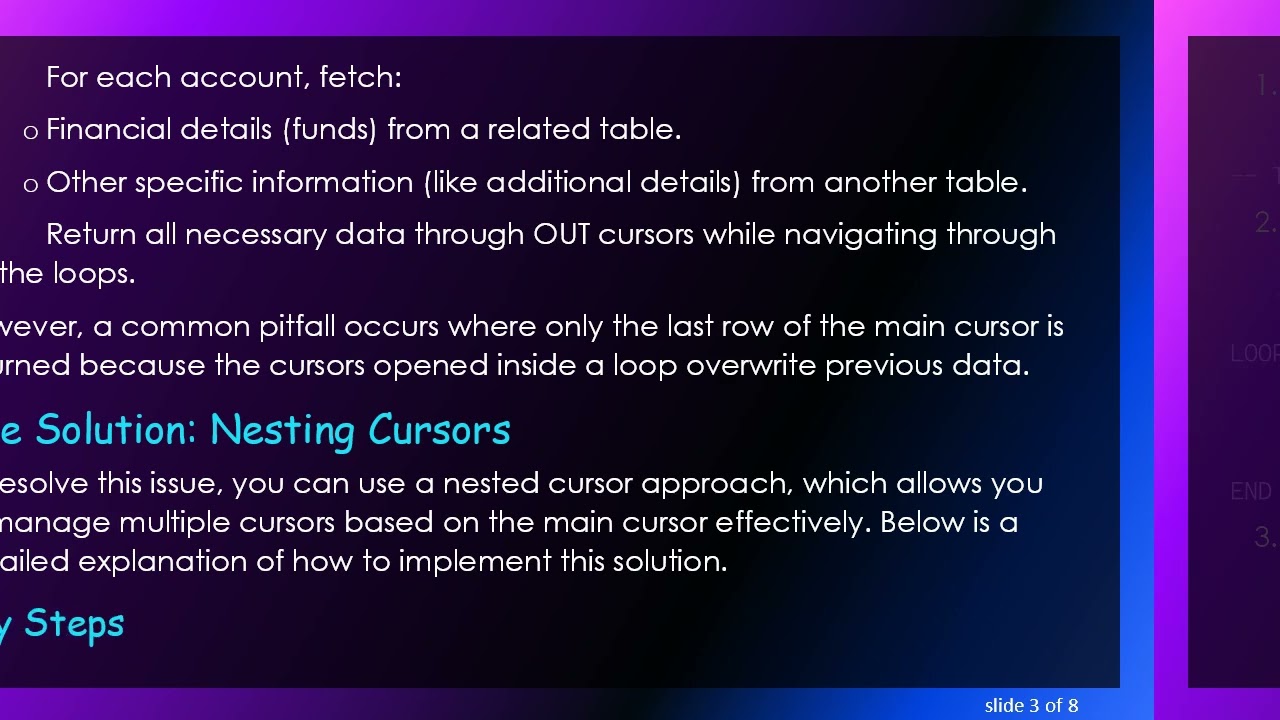
For each account, fetch:
Financial details (funds) from a related table.
Other specific information (like additional details) from another table.
Return all necessary data through OUT cursors while navigating through the loops.
However, a common pitfall occurs where only the last row of the main cursor is returned because the cursors opened inside a loop overwrite previous data.
The Solution: Nesting Cursors
To resolve this issue, you can use a nested cursor approach, which allows you to manage multiple cursors based on the main cursor effectively. Below is a detailed explanation of how to implement this solution.
Key Steps
Declare the Type of Cursors:
Make sure your cursor types are well-defined at the beginning.
[[See Video to Reveal this Text or Code Snippet]]
Loop through the Main Cursor:
Open and fetch through your main cursor inside a loop. Use PL/SQL blocks to manage the data efficiently.
[[See Video to Reveal this Text or Code Snippet]]
Open Nested Cursors:
Inside your loop, open additional cursors based on the current row of the main cursor.
[[See Video to Reveal this Text or Code Snippet]]
Use Bulk Collect:
Instead of processing rows one by one, consider using BULK COLLECT to fetch multiple rows into collections. This approach is useful for improving performance and reducing context switches.
[[See Video to Reveal this Text or Code Snippet]]
Aggregate and Return Data:
Finally, aggregate the inner cursor results into a structured format, such as JSON, to ensure clarity and ease of retrieval.
[[See Video to Reveal this Text or Code Snippet]]
Full Implementation Example
Here is a condensed example of how everything ties together:
[[See Video to Reveal this Text or Code Snippet]]
Conclusion
Using nested cursors efficiently allows you to gather related data from various tables while keeping your output structured and clear. By implementing BULK COLLECT for performance and leveraging JSON for data representation, your Oracle procedures can become more robust and easier to manage.
By mastering the handling of multiple cursors, you will not only improve efficiency but also enhance the clarity of your database interactions.
For those facing similar challenges, remember that understanding your data structure and utilizing Oracle’s powerful cursor capabilities can lead to more effective database solutions!
Доступные форматы для скачивания:
Скачать видео mp4
-
Информация по загрузке: