Популярное

Музыка Кино и Анимация Автомобили Животные Спорт Путешествия Игры Юмор

Интересные видео

2025 Сериалы Трейлеры Новости Как сделать Видеоуроки Diy своими руками

Топ запросов

смотреть а4 schoolboy runaway турецкий сериал смотреть мультфильмы эдисон
dTub
Скачать

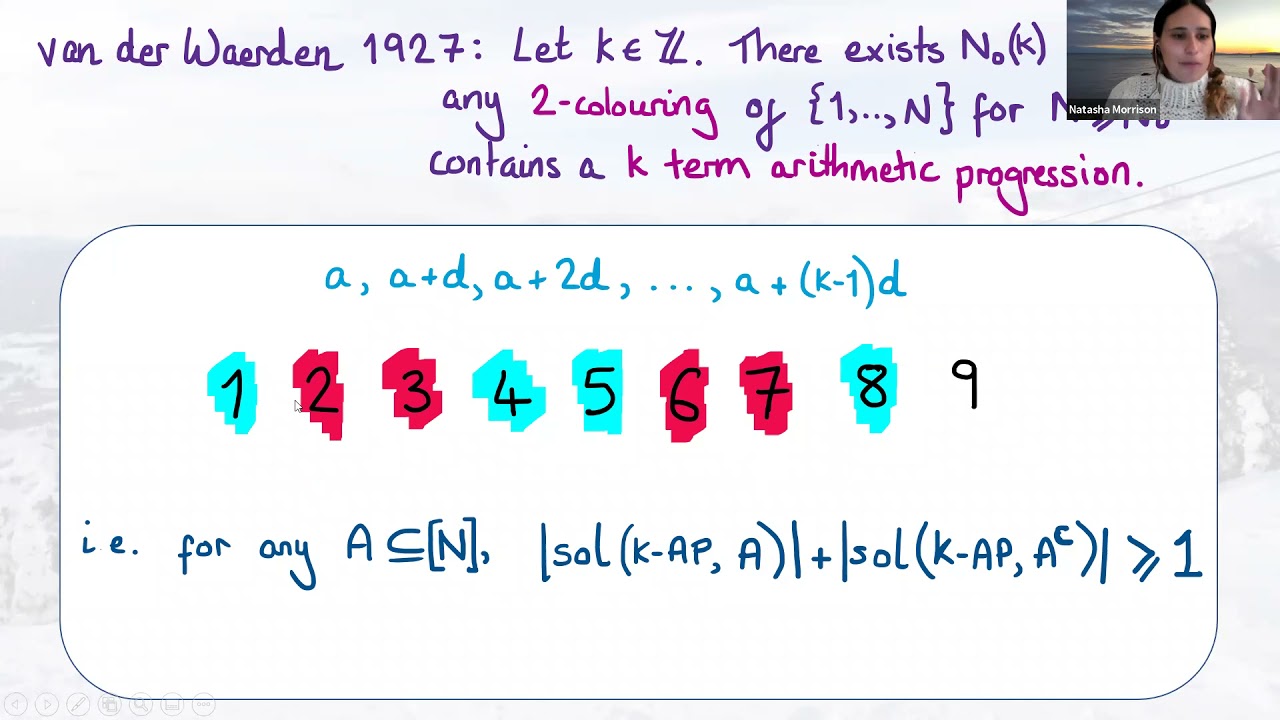
Natasha Morrison (Victoria): Uncommon systems of equations

Автор: Webinar in Additive Combinatorics

Загружено: 2021-10-22

Просмотров: 257

Описание:

A system of linear equations $L$ over $\mathbb{F}_q$ is \emph{common} if the number of monochromatic solutions to $L$ in any two-colouring of $\mathbb{F}_q^n$ is asymptotically at least the expected number of monochromatic solutions in a random two-colouring of $\mathbb{F}_q^n$. Motivated by existing results for specific systems (such as Schur triples and arithmetic progressions), as well as extensive research on common and Sidorenko graphs, the systematic study of common systems of linear equations was recently initiated by Saad and Wolf. Building on earlier work of of Cameron, Cilleruelo and Serra, as well as Saad and Wolf, common linear equations have been fully characterised by Fox, Pham and Zhao.

In this talk I will discuss some recent progress towards a characterisation of common systems of two or more equations. In particular we prove that any system containing an arithmetic progression of length four is uncommon, confirming a conjecture of Saad and Wolf. This follows from a more general result which allows us to deduce the uncommonness of a general system from certain properties of one- or two-equation subsystems.
Natasha Morrison (Victoria): Uncommon systems of equations

Поделиться в:

Доступные форматы для скачивания:

Скачать видео mp4

  • Информация по загрузке:

Скачать аудио mp3

Похожие видео

Ben Green (Oxford): Quadratic forms in 8 prime variables

Ben Green (Oxford): Quadratic forms in 8 prime variables

Jared Duker Lichtman (Oxford): Twin primes & a modified linear sieve

Jared Duker Lichtman (Oxford): Twin primes & a modified linear sieve

Orit Raz (HUJI): Expanding polynomials and the discretized Elekes-R\'onyai theorem

Orit Raz (HUJI): Expanding polynomials and the discretized Elekes-R\'onyai theorem

Thomas Bloom (Oxford): A density conjecture about unit fractions

Thomas Bloom (Oxford): A density conjecture about unit fractions

Matthew Tointon (Bristol): Percolation on finite transitive graphs

Matthew Tointon (Bristol): Percolation on finite transitive graphs

Magnus Carlsen Plays The Messi Of Chess

Magnus Carlsen Plays The Messi Of Chess

I Played My GM Mom in an OFFICIAL Chess Tournament!!!!!

I Played My GM Mom in an OFFICIAL Chess Tournament!!!!!

Ludzie ubożeją i zaczynają być zdesperowani, a Domański zamiata sprawę pod dywan | A. Klarenbach

Ludzie ubożeją i zaczynają być zdesperowani, a Domański zamiata sprawę pod dywan | A. Klarenbach

Niels Bohr Explains Why the Past Isn’t Really Gone | Time, Quantum Physics & Reality

Niels Bohr Explains Why the Past Isn’t Really Gone | Time, Quantum Physics & Reality

Wyjaśniamy o co chodzi z Grenlandią. Czy naprawdę może wybuchnąć wojna USA-Dania?

Wyjaśniamy o co chodzi z Grenlandią. Czy naprawdę może wybuchnąć wojna USA-Dania?

Prawdziwy Powód, Dlaczego Psy CIĘ LIŻĄ (Szokujące!)

Prawdziwy Powód, Dlaczego Psy CIĘ LIŻĄ (Szokujące!)

Код работает в 100 раз медленнее из-за ложного разделения ресурсов.

Код работает в 100 раз медленнее из-за ложного разделения ресурсов.

Freddie Manners (UCSD): Iterated Cauchy--Schwarz arguments and true complexity

Freddie Manners (UCSD): Iterated Cauchy--Schwarz arguments and true complexity

Измучены после работы каждый день? — Посмотрите это видео.

Измучены после работы каждый день? — Посмотрите это видео.

Only 1% Solve This! Germany Math Olympiad Problem

Only 1% Solve This! Germany Math Olympiad Problem

Why Does Fire BURN? Feynman's Answer Will DESTROY Your Reality

Why Does Fire BURN? Feynman's Answer Will DESTROY Your Reality

Lisa Sauermann (MIT/IAS): Finding solutions with distinct variables to systems of equations over F_p

Lisa Sauermann (MIT/IAS): Finding solutions with distinct variables to systems of equations over F_p

Max Wenqiang Xu (Stanford): Product sets of arithmetic progressions

Max Wenqiang Xu (Stanford): Product sets of arithmetic progressions

The Time Paradox Hidden Inside Feynman’s Nobel Prize Work

The Time Paradox Hidden Inside Feynman’s Nobel Prize Work

Why We Are

Why We Are "TRAPPED" In The Milky Way | Brian Cox

© 2025 dtub. Все права защищены.


  • Контакты
  • О нас
  • Политика конфиденциальности


Контакты для правообладателей: infodtube@gmail.com