Lisa Sauermann (MIT/IAS): Finding solutions with distinct variables to systems of equations over F_p
Автор: Webinar in Additive Combinatorics
Загружено: 2021-05-24
Просмотров: 746
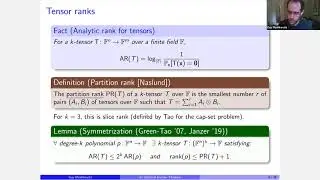
Let us fix a prime p and a homogeneous system of m linear equations a_{j,1}x_1+\dots+a_{j,k}x_k=0 for j=1,\dots,m with coefficients a_{j,i}\in\mathbb{F}_p. Suppose that k\geq 3m, that a_{j,1}+\dots+a_{j,k}=0 for j=1,\dots,m and that every m\times m minor ofthe m\times k matrix (a_{j,i})_{j,i} is non-singular. Then we prove that for any (large) n, any subset A\subseteq\mathbb{F}_p^n of size |A| greater than C\cdot \Gamma^n contains a solution (x_1,\dots,x_k)\in A^k to the given system of equations such that the vectors x_1,\dots,x_k\inA are all distinct. Here, C and \Gamma are constants only depending on p, m and k such that \Gamma less than p. The crucial point here is the condition for the vectors x_1,\dots,x_k in the solution (x_1,\dots,x_k)\in A^k to be distinct. If we relax this condition and only demand that x_1,\dots,x_k are not all equal, then the statement would follow easily from Tao’s slicerank polynomial method. However, handling the distinctness condition is much harder, and requires a new approach. While all previous combinatorial applications of the slice rank polynomial method have relied on the slice rank of diagonal tensors, we use a slicerank argument for a non-diagonal tensor in combination with combinatorial and probabilistic arguments.

Доступные форматы для скачивания:
Скачать видео mp4
-
Информация по загрузке: