How to Pass Function Component Context as Parameter in React: A Guide to Using useSnackbar Hook
Автор: vlogize
Загружено: 2025-10-11
Просмотров: 0
Discover how to overcome the challenge of using the `useSnackbar` hook in React by creating a custom hook. Learn step-by-step how to pass function component context seamlessly.
---
This video is based on the question https://stackoverflow.com/q/68488782/ asked by the user 'Vallo' ( https://stackoverflow.com/u/2502135/ ) and on the answer https://stackoverflow.com/a/68489610/ provided by the user 'Soufiane Boutahlil' ( https://stackoverflow.com/u/11498568/ ) at 'Stack Overflow' website. Thanks to these great users and Stackexchange community for their contributions.
Visit these links for original content and any more details, such as alternate solutions, latest updates/developments on topic, comments, revision history etc. For example, the original title of the Question was: Pass function component context as parameter in React
Also, Content (except music) licensed under CC BY-SA https://meta.stackexchange.com/help/l...
The original Question post is licensed under the 'CC BY-SA 4.0' ( https://creativecommons.org/licenses/... ) license, and the original Answer post is licensed under the 'CC BY-SA 4.0' ( https://creativecommons.org/licenses/... ) license.
If anything seems off to you, please feel free to write me at vlogize [AT] gmail [DOT] com.
---
How to Pass Function Component Context as Parameter in React: A Guide to Using useSnackbar Hook
In the realm of React development, managing notifications within your components can sometimes be tricky, especially when using hooks. One common issue developers encounter is how to effectively utilize the useSnackbar hook from the notistack library within a functional component. This post aims to clarify this dilemma and provide a simple solution.
The Challenge
You might have come across the limitation stating that "Hooks can only be called inside the body of a function component." If you've attempted to create a wrapper function around useSnackbar, you likely found that passing the component context or using this is ineffective. This limitation can hinder the way you want to structure your notification logic.
Suppose you want to create a user-friendly interface for notifications, such as alert, warn, info, and success. Here's what you might have tried previously:
[[See Video to Reveal this Text or Code Snippet]]
The above code will result in an error since it's trying to execute a hook outside its proper context.
The Solution: Using a Custom Hook
The solution lies in creating a custom hook that integrates the useSnackbar hook into its body. Here’s how you can structure it effectively:
Step 1: Creating the Custom Hook
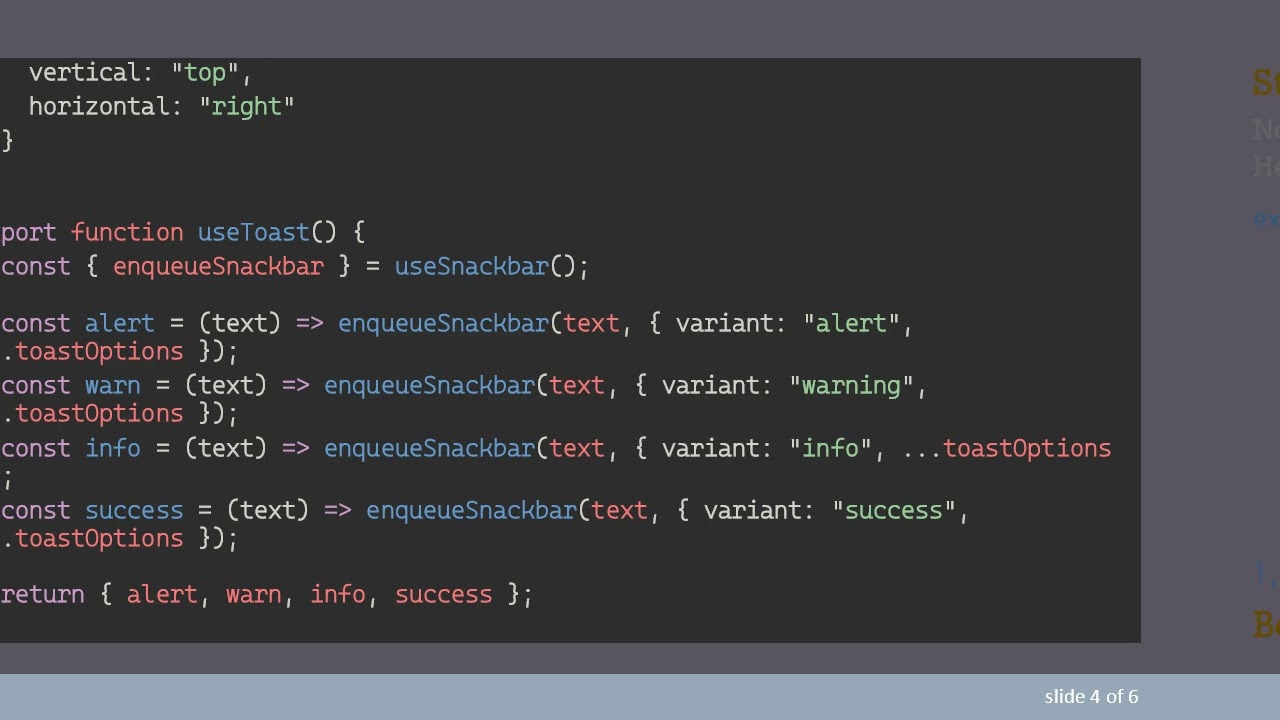
Let's create a custom hook called useToast that encapsulates the useSnackbar logic:
[[See Video to Reveal this Text or Code Snippet]]
Step 2: Integrating the Hook in Your Component
Now, you can utilize this useToast custom hook within any functional component. Here's an example:
[[See Video to Reveal this Text or Code Snippet]]
Benefits of This Approach
Clean Separation: The notification logic is encapsulated within a custom hook, making your components cleaner and more focused.
Reusability: You can use the useToast hook in any component throughout your application without repeating code.
Flexibility: By adjusting the configuration in toastOptions, you can easily customize the appearance and behavior of your notifications.
Conclusion
By creating a custom hook, you can effectively bypass the limitation of using useSnackbar outside of a function component. This approach not only simplifies your code but also enhances maintainability and reusability.
Now, you can confidently create a notification system in your React application without the hassle of managing component context directly. Happy coding!
Доступные форматы для скачивания:
Скачать видео mp4
-
Информация по загрузке: