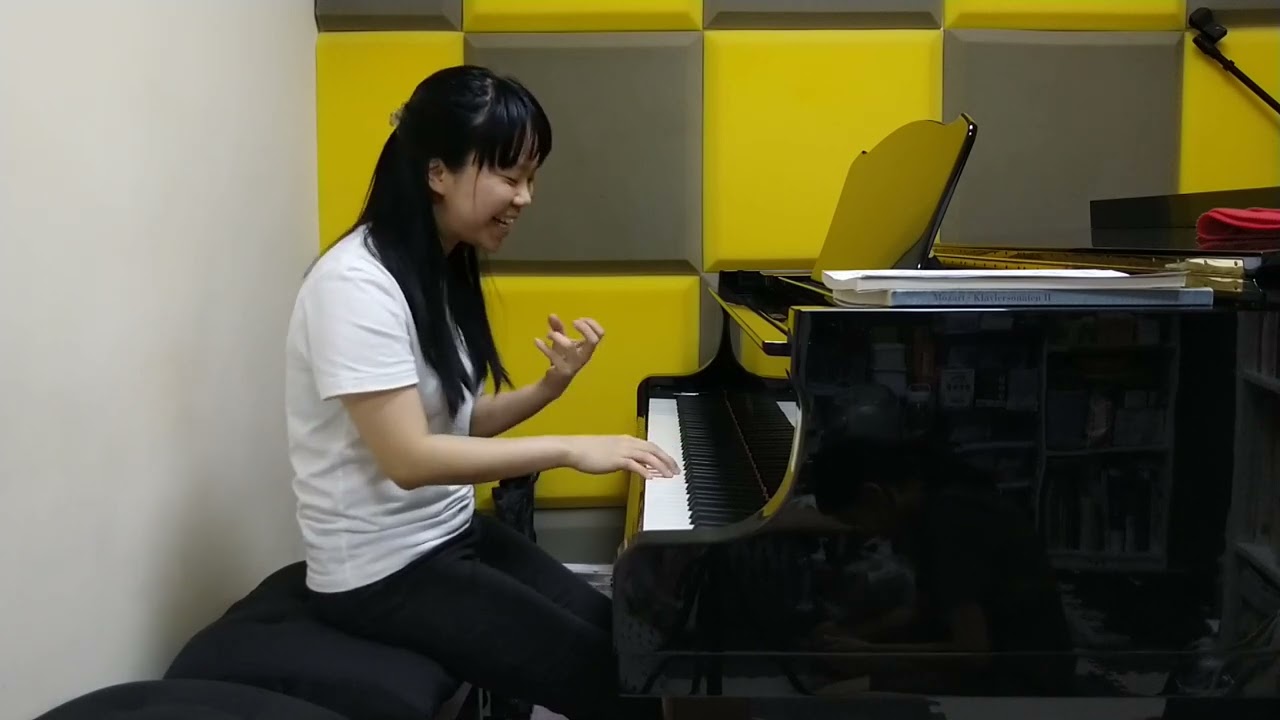
Schumann Piano Concerto 1st Movement Explanation on Piano II
Автор: Whale Music Journal
Загружено: 2023-05-22
Просмотров: 143
Recorded for my piano II guy lol
12/5/2023
English translation:
00:15 The E should be sustained enough for the soloist to carry the energy onwards
00:36 similarly, piano I's A chord is going to relay over to orchestra.
00:58
A B C E - beautiful landing on the Dmin9 chord
B - Bb - A : observe the harmony change
turn : needs to be clear and very elaborative
F - C# - D : observe the harmony very well, especially that
more pointed fingers so that the melody is more focused and delicate.
02:27 the 5-plets is very string-like and tender.
soloist shall give a cue to start, and soloist LH breath and tempo syncs with orch.
(there is also the syncopation element but I didn't mention in the video)
03:21 i like this part more light and airy.
03:33 i always think of it like blooming from mud, or birds soaring into the sky in an Amazon forest. penetrating should be the keyword.
04:37 soloist and orch should be doing this tgt, very horn-like, warm sound. also cresc. it must be very legato played. i used fingering 1-4, 2-5 , 1-3 for the first three chords. if it is a technical challenge, orch should make sure still to make it very very legato.
05:48 there was much energy from soloist so that the orch must carry it forward. Do not make it carnival-sounding...
06:23 is a decent surprise, it should have a clash with the soloist while the soloist interrupts the orch with the powerful octaves. that C# should sound really explicit and unexpected.
recap 06:56
starting from 07:00 it's more to do with solo, so there is not much input required from orch.
07:38 I usually hope the high Ab is tenderly expressed (sf), but this requires collaboration between the orchestra and the solo. But sometimes I like it a bit rushed.
08:36 on the overall structure design, note the ascending sequence. each time more and more, preferably with more and more tenuto.
08:53 for this little phrase, both orch and solo has this melody, it's a very very long, each time pulling it a bit higher and higher but anti-climax around 09:13. simple but tender melody, and I think it depends completely on how the movement physically works, in terms of getting the timing.
09:30 after going that faraway, then we gradually come back layer by layer. then we come back to 09:51.
09:55 then we come to the conversation. for the ornament I intend it to be poetic.
10:28 it's a conversation so better that the oboe and solo has that awareness.
10:21 there is a rit from soloist so that there needs to be collaboration.
11:03 there is a melody that is really broad-sounding so that there is much rubato, the orch needs to listen actively to what the soloist is thinking.
11:24 starting from small, then gradually getting really loud.
11:31 there should be a clear cue as the section changes.
11:42 i particularly like this chord as it is so deep. sometimes i like putting a little tenuto there.
11:50 piano II time...
good if the tremolo and counterpoint is kept.
however if not ok, the harmony should be there. nevertheless better have a full 4-part voicing. don't give empty 5ths...
12:40 in terms of structure, it is going down , then minor, then Ab.
12:59 re-cap again
lots of pulling around the tempo, and in my mind it depends on these stuff 13:25
13:40 a little olive-shaped dynamics. then slowly building up, then 14:06 the majestic gesture.
14:30 counting 1, 2, 3, 4, then minor, then Ab.
14:44 tend to be slower in this section.
soloist listening for the C, Bb, Ab to get the tempo. That depends on the space.
15:01 make sure the counter-melody is there for the soloist. again with 15:13.
15:14 towards the soloist - this phrase is more of an incomplete cadence, so it would not be very dominant sounding.
15:24 if i recall correctly there is a melody from orch - and that doesn't require a firm sound because it is also in an imperfect cadence + ii7bo - V of Bb minor.
15:33 - then soloist's turn - which is an answer to the previous sentence.
15:41 - the orch Bb should soar as it is a very high note. deserves some attention to create a bit of rubato. it was also prepared by the soloist (15:53)
16:10 - i think there was a little counter-melody by the orch as well, like an exclamation.
16:23 for this whole section I think it's like Widmung. full of love and dedication. haha
and needs lots of conversation-like call and response.
fast forwarding to...
16:56 for this section, it's a lot of modulation. mostly of stepwise motion but every time a bit of modulation, as highlighted in my playing. for the first-half motion (stepwise), I prefer some sneaking up and down dynamics. for the second-half motion (octave leaps 18:17), I prefer some rubato , the extent of which depends on the kind of harmony presented.
17:49 but i think also the bass is important...but i always forgot to listen to that haha. not sure if orch has that. if yes would be lovely to do tgt.
18:34 is even more, very high E.
18:44 going down bit by bit. with syncopation.
(word limit reached :') end for now)
Доступные форматы для скачивания:
Скачать видео mp4
-
Информация по загрузке: