Cardiac Anatomy, Human Anatomy, USMLE Step 1 - Full Vignette with Extended Explanations
Автор: EndlessMedical.Academy
Загружено: 2025-12-30
Просмотров: 3
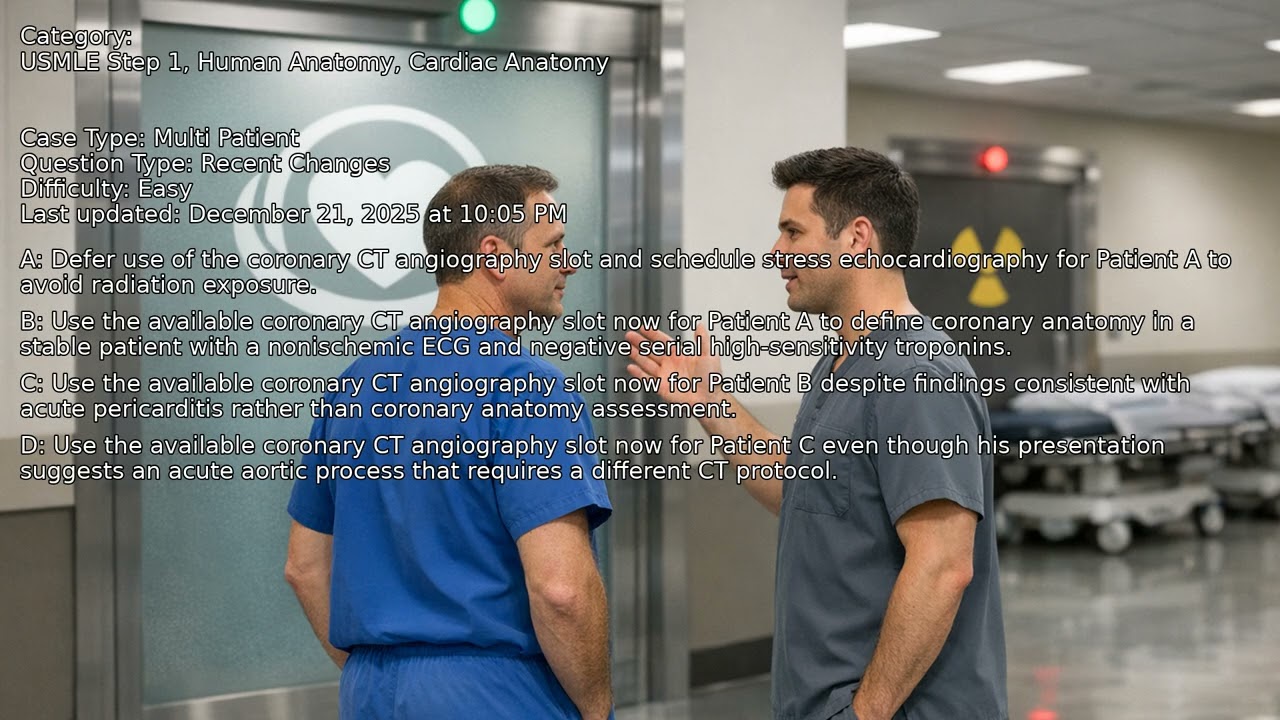
Three patients present to the emergency department during a surge in imaging demand, each with distinct chest discomfort and clinical findings. With limited immediate access to a cardiac CT angiography slot and other protocols delayed, what clinical factors should guide your imaging prioritization? How do patient symptoms and physical exam findings inform which case benefits most from dedicated coronary CT angiography?
VIDEO INFO
Category: Cardiac Anatomy, Human Anatomy, USMLE Step 1
Difficulty: Easy - Basic level - Suitable for medical students
Question Type: Recent Changes
Case Type: Multi Patient
Explore more ways to learn on this and other topics by going to https://endlessmedical.academy/auth?h...
QUESTION
You are triaging three patients with chest discomfort during a surge in ED imaging. Radiology reports that multiple trauma cases from a highway collision have occupied the general CT scanners....
OPTIONS
A. Use the available coronary CT angiography slot now for Patient A to define coronary anatomy in a stable patient with a nonischemic ECG and negative serial high-sensitivity troponins.
B. Use the available coronary CT angiography slot now for Patient B despite findings consistent with acute pericarditis rather than coronary anatomy assessment.
C. Use the available coronary CT angiography slot now for Patient C even though his presentation suggests an acute aortic process that requires a different CT protocol.
D. Defer use of the coronary CT angiography slot and schedule stress echocardiography for Patient A to avoid radiation exposure.
CORRECT ANSWER
A. Use the available coronary CT angiography slot now for Patient A to define coronary anatomy in a stable patient with a nonischemic ECG and negative serial high-sensitivity troponins.
EXPLANATION
"Use the available coronary CT angiography slot now for Patient A to define coronary anatomy in a stable patient with a nonischemic ECG and negative serial high-sensitivity troponins." This decision follows a simple triage rule from contemporary chest pain pathways: in a stable patient with exertional chest discomfort, a nonischemic ECG, and negative serial high-sensitivity troponins, an early anatomic test that directly images the coronary arteries is appropriate and efficient. Coronary CT angiography (CCTA) rapidly evaluates coronary origin, course, and luminal stenosis, and it is the exact protocol the cardiac CT system is configured to run immediately. Per the 2021 AHA/ACC Chest Pain guideline, CCTA is recommended in stable chest pain when rule-out myocardial infarction testing is negative and the ECG is nondiagnostic, especially when timely anatomic clarification can guide disposition and reduce downstream testing.
By contrast, Patient B s positional, pleuritic pain with a triphasic pericardial friction rub and diffuse concave ST elevation with PR depression is classic for acute pericarditis; she needs anti-inflammatory therapy and risk stratification rather than coronary luminal imaging. Patient C s sudden tearing pain radiating to the back, inter-arm blood pressure difference, and a new early diastolic murmur strongly suggest an acute aortic syndrome with acute aortic regurgitation, which requires an aortic CTA protocol, not a coronary-only protocol....
---------------------------------------------------
Our cases and questions come from the https://EndlessMedical.Academy quiz engine - multi-model platform. Each question and explanation is forged by consensus between multiple top AI models (GPT, Claude, Grok, etc.), with automated web searches for the latest research and verified references. Calculations (e.g. eGFR, dosages) are checked via code execution to eliminate errors, and all references are reviewed by several AIs to minimize hallucinations.
Important note: This material is entirely AI-generated and has not been verified by human experts; despite stringent consensus checks, perfect accuracy cannot be guaranteed. Exercise caution - always corroborate the content with trusted references or qualified professionals, and never apply information from this book to patient care or clinical decisions without independent verification.
Clinicians already rely on AI and online tools - myself included - so treat this book as an additional focused aid, not a replacement for proper medical education. Visit https://endlessmedical.academy for more AI-supported resources and cases.
This material can not be treated as medical advice. May contain errors.
---------------------------------------------------
Доступные форматы для скачивания:
Скачать видео mp4
-
Информация по загрузке: