How to Iterate Through File Names and Print Them with pathlib.glob()
Автор: vlogize
Загружено: 2025-09-14
Просмотров: 0
Learn how to easily iterate through file names in a directory and print the desired format using Python's `pathlib` module and `glob` method.
---
This video is based on the question https://stackoverflow.com/q/62381586/ asked by the user 'Leockl' ( https://stackoverflow.com/u/12462568/ ) and on the answer https://stackoverflow.com/a/62381761/ provided by the user 'Shivam Bharadwaj' ( https://stackoverflow.com/u/5591519/ ) at 'Stack Overflow' website. Thanks to these great users and Stackexchange community for their contributions.
Visit these links for original content and any more details, such as alternate solutions, latest updates/developments on topic, comments, revision history etc. For example, the original title of the Question was: How to iterate through file names and print out the corresponding file names with pathlib.glob()
Also, Content (except music) licensed under CC BY-SA https://meta.stackexchange.com/help/l...
The original Question post is licensed under the 'CC BY-SA 4.0' ( https://creativecommons.org/licenses/... ) license, and the original Answer post is licensed under the 'CC BY-SA 4.0' ( https://creativecommons.org/licenses/... ) license.
If anything seems off to you, please feel free to write me at vlogize [AT] gmail [DOT] com.
---
Iterating Through File Names with pathlib.glob()
When you're working with files in Python, iterating through file names can sometimes feel daunting—especially if you're trying to format the output in a specific way. If you've ever encountered a scenario where you need to iterate over files in a directory and print them with certain modifications, you're not alone! In this guide, we will explore how to do this using Python's pathlib module and its glob() method.
The Problem
Imagine you have a directory filled with CSV files like the following:
[[See Video to Reveal this Text or Code Snippet]]
You want to loop through these files and print their names in a specific format: you’d like to display the prefix (P1, P5, etc.) followed by the first three letters of the word SAMPLE in lowercase. The desired output format would look like this:
[[See Video to Reveal this Text or Code Snippet]]
But how do you accomplish this? Let's dive into the solution!
The Solution
To achieve the desired output, we will harness the power of the pathlib module in Python. Below is the step-by-step approach to write the function needed to iterate through the files.
Step 1: Import the Path Class
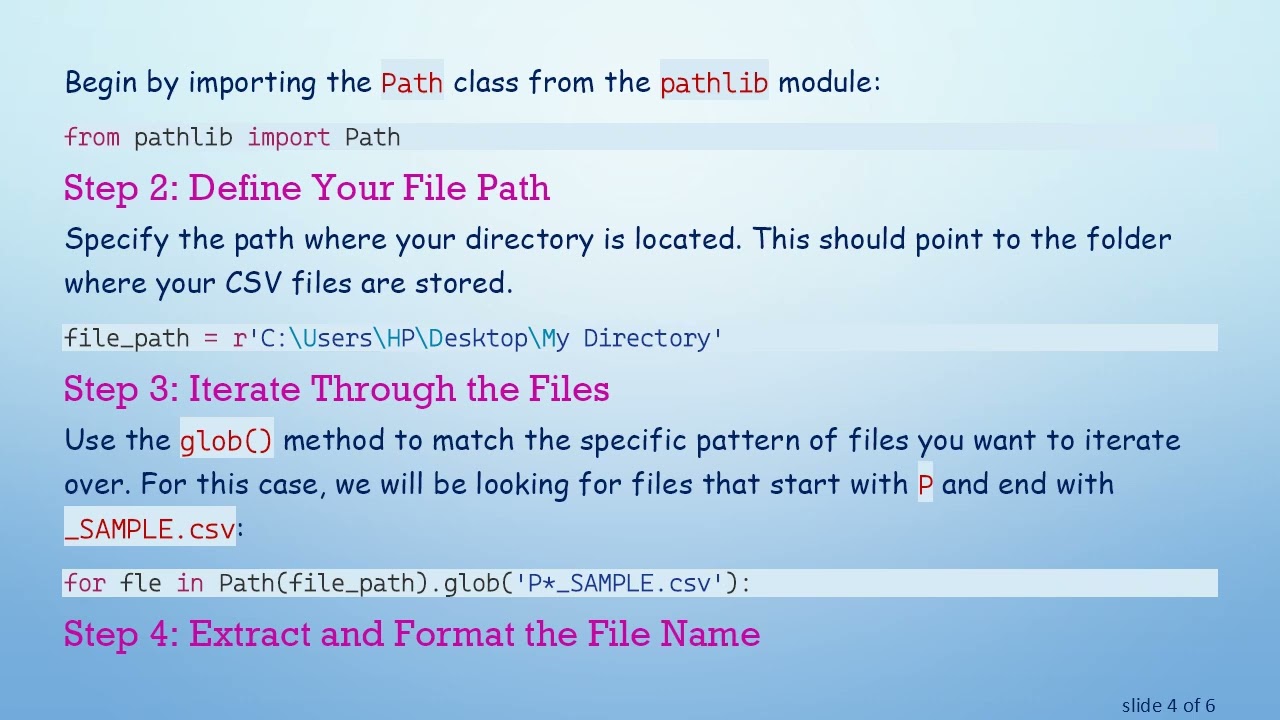
Begin by importing the Path class from the pathlib module:
[[See Video to Reveal this Text or Code Snippet]]
Step 2: Define Your File Path
Specify the path where your directory is located. This should point to the folder where your CSV files are stored.
[[See Video to Reveal this Text or Code Snippet]]
Step 3: Iterate Through the Files
Use the glob() method to match the specific pattern of files you want to iterate over. For this case, we will be looking for files that start with P and end with _SAMPLE.csv:
[[See Video to Reveal this Text or Code Snippet]]
Step 4: Extract and Format the File Name
Inside the loop, split the file name to extract the desired distinct parts. We will split the name on the underscore (_) to separate the prefix from 'SAMPLE' and then format it as desired:
[[See Video to Reveal this Text or Code Snippet]]
Complete Code Snippet
Here is the complete code that combines all of the above steps:
[[See Video to Reveal this Text or Code Snippet]]
Output
Running this code will give you the following output:
[[See Video to Reveal this Text or Code Snippet]]
Conclusion
By using Python's pathlib module alongside the glob() method, you can efficiently iterate over files in a directory and format their names as needed. This solution is not only straightforward but also quite powerful for handling file operations in a structured manner.
Now you can easily adapt this approach to fit any similar need in your projects. Happy coding!
Доступные форматы для скачивания:
Скачать видео mp4
-
Информация по загрузке: