Fixing Numpy Array Shapes: How to Preserve the Greyscale Color Channel When Converting Images
Автор: vlogize
Загружено: 2025-09-03
Просмотров: 0
Learn how to convert a greyscale image into a Numpy array with the desired shape, ensuring you keep the color channel intact while working with Python.
---
This video is based on the question https://stackoverflow.com/q/64568012/ asked by the user 'Song Tùng' ( https://stackoverflow.com/u/10733376/ ) and on the answer https://stackoverflow.com/a/64569602/ provided by the user 'Crazy Coder' ( https://stackoverflow.com/u/13482440/ ) at 'Stack Overflow' website. Thanks to these great users and Stackexchange community for their contributions.
Visit these links for original content and any more details, such as alternate solutions, latest updates/developments on topic, comments, revision history etc. For example, the original title of the Question was: Numpy array not displaying color dimension of greyscale image after converting from PIL image
Also, Content (except music) licensed under CC BY-SA https://meta.stackexchange.com/help/l...
The original Question post is licensed under the 'CC BY-SA 4.0' ( https://creativecommons.org/licenses/... ) license, and the original Answer post is licensed under the 'CC BY-SA 4.0' ( https://creativecommons.org/licenses/... ) license.
If anything seems off to you, please feel free to write me at vlogize [AT] gmail [DOT] com.
---
Understanding the Problem: Numpy Array Shape with Greyscale Images
When working with images in Python, one common task is converting an RGB image to a greyscale format. However, after this conversion, you might notice a problem when trying to turn the image into a Numpy array. The concern arises when the resulting shape of the Numpy array does not include a color channel, creating confusion for those who expect a three-dimensional array for their greyscale images.
In the following explanation, we will dive deep into how to correctly convert a greyscale image into a Numpy array while preserving its dimension for a color channel. This will ensure that your array has the shape (128, 128, 1) instead of the unexpected (128, 128).
Step-by-Step Solution
1. Initial Setup
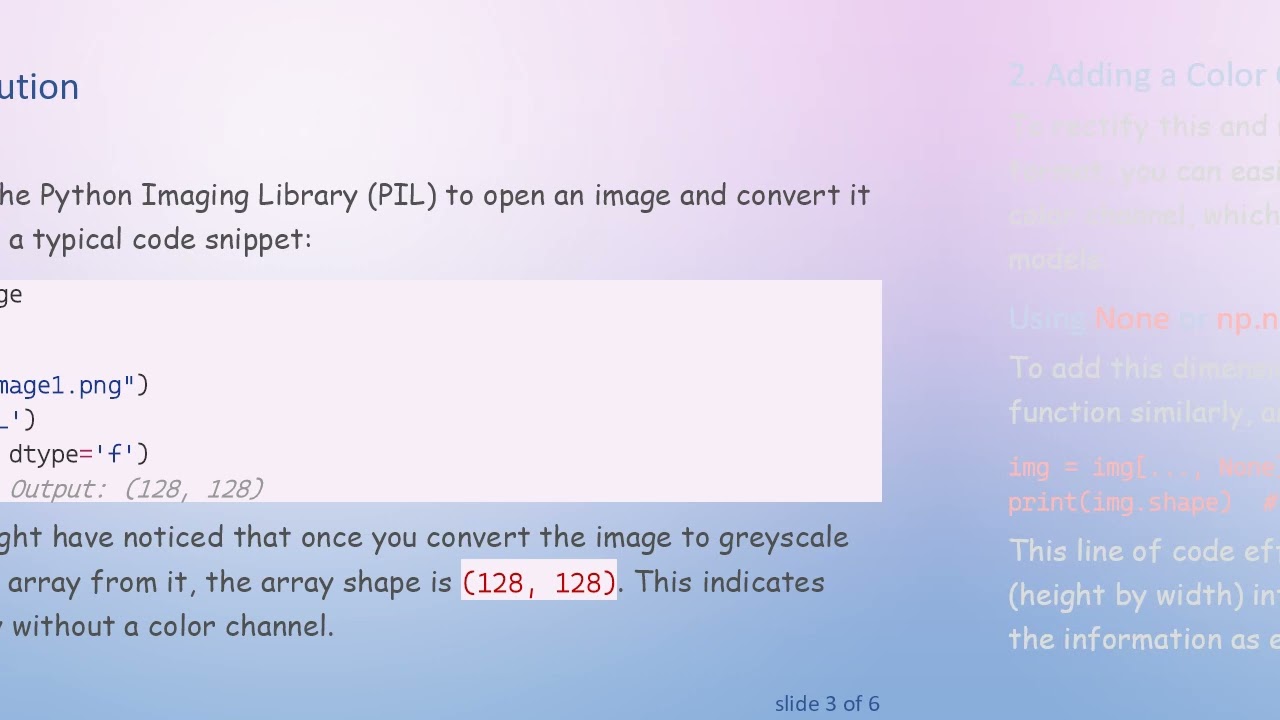
You start by using the Python Imaging Library (PIL) to open an image and convert it to greyscale. Here’s a typical code snippet:
[[See Video to Reveal this Text or Code Snippet]]
In this code, you might have noticed that once you convert the image to greyscale and create a Numpy array from it, the array shape is (128, 128). This indicates that it is a 2D array without a color channel.
2. Adding a Color Channel Dimension
To rectify this and make sure your Numpy array reflects a single-channel image format, you can easily add an extra dimension. This extra dimension represents the color channel, which is essential for various applications, especially in deep learning models.
Using None or np.newaxis
To add this dimension, you can utilize either None or np.newaxis. Both methods function similarly, and here's how you can implement it:
[[See Video to Reveal this Text or Code Snippet]]
This line of code effectively reshapes your array, transforming it from a 2D array (height by width) into a 3D array (height by width by channel), thereby preserving the information as expected.
3. Summary of the Changes
Original Shape: (128, 128) - This represents a 2D greyscale array without a channel.
Modified Shape: (128, 128, 1) - This format includes a third dimension for the channel, indicative of a single-channel greyscale image.
4. Conclusion
By adding an axis to the end of your Numpy array, you can solve the problem of missing the color dimension when working with greyscale images. This minor adjustment allows for better compatibility with functions that expect an array with color channels, making your image processing tasks smoother and more efficient.
Now you can confidently work with greyscale images and ensure your Numpy arrays reflect the correct structure, enhancing your data handling as you progress in the world of image processing in Python.
Доступные форматы для скачивания:
Скачать видео mp4
-
Информация по загрузке:









![Как сжимаются изображения? [46 МБ ↘↘ 4,07 МБ] JPEG в деталях](https://image.4k-video.ru/id-video/Kv1Hiv3ox8I)