Building Regulations (England) - Guide to Approved Document Q - Security in Dwellings
Автор: Building Regulations Copilot
Загружено: 2025-12-21
Просмотров: 32
Building a safe home is about more than just a feeling; it is a legal mandate.
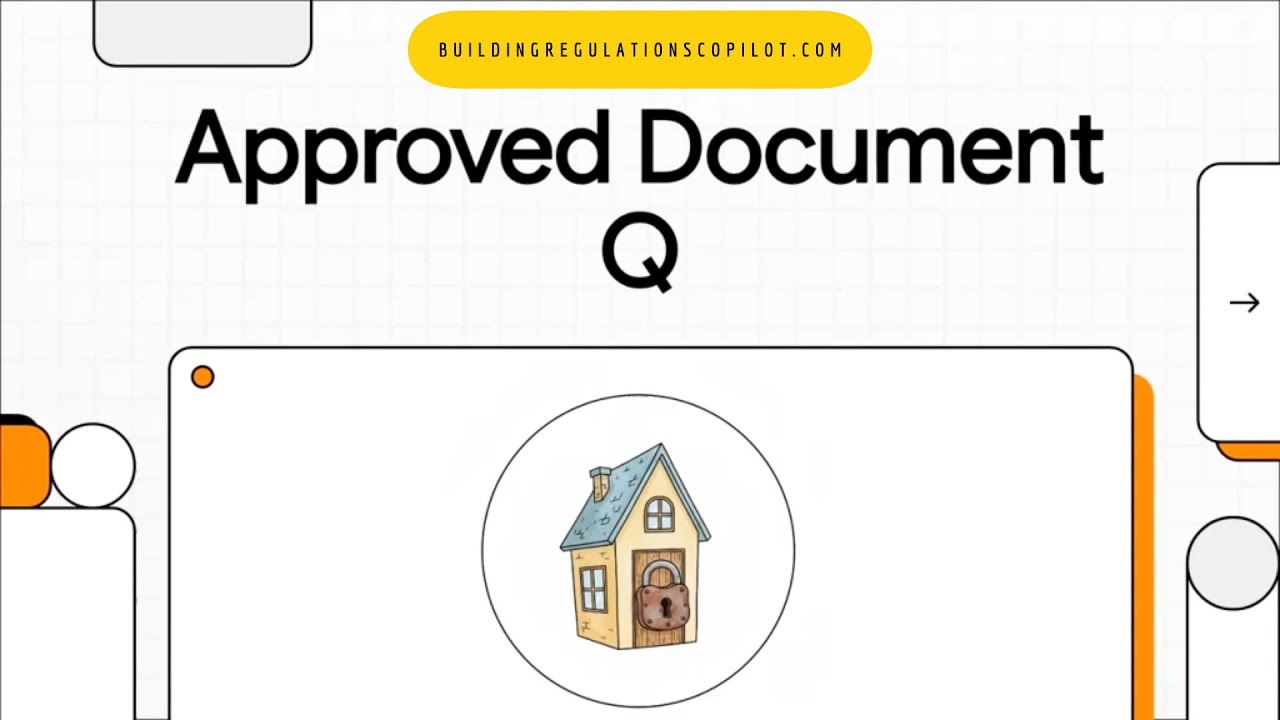
This video provides a deep dive into Approved Document Q, the official instruction manual for meeting Requirement Q1, which dictates that all new dwellings must be built to reasonably resist a break-in. Failing to meet these standards can lead to failed inspections, project delays, and costly rework.
Who Does This Apply To?
Approved Document Q is mandatory for all brand-new homes in England.
Crucially, it also applies to conversions, such as turning an old office block into flats or performing a barn conversion - any project involving a "material change of use" that creates a new dwelling.
The "Easily Accessible" Test
The regulations focus on the most likely points of entry.
To determine if a door or window must be secured, we use the "2-meter bubble" rule: if any part of a window or door is within 2 meters of the ground, a balcony, or a basement light well, it is considered "easily accessible" and must be a secure unit.
We also cover the "garage roof loophole," where windows within 2 meters of a flat roof (that is itself within 3.5 meters of the ground) are also classified as accessible.
Technical Standards for Doors and Windows
• The Gold Standard: To prove a door or window is secure, it should generally be certified to the PAS24 standard.
• Door Hardware: Secure door sets must include a door viewer (unless there is clear glass nearby) and a door chain or limiter.
• Locking Systems: The preferred choice is a multi-point locking system, though heavy-duty mortise locks combined with rim locks are an alternative.
• Letter Plates: These are limited to a maximum size of 260x40 mm and must be designed to prevent "key fishing".
The Critical Installation Rule
The best security products are useless if they aren't installed correctly. Expanding foam alone is not compliant. Every frame must be mechanically fixed with screws or bolts directly into the building structure. For lightweight or timber-frame walls, you must include a resilient layer (like 9mm plywood or expanded metal) extending 600 mm from each side of the door to prevent someone from kicking through the wall to reach the lock.
Following these rules ensures your project is not just a building, but a secure home ready for sign-off.
Analogy for Understanding:
Think of Approved Document Q as the "Immune System" of a house. Just as an immune system identifies and strengthens the body’s most vulnerable entry points against external threats, these regulations identify the "easily accessible" parts of a building and mandate "resilient layers" and "certified hardware" to ensure the home can naturally resist an intruder's attempt to break in.
--------------------------------------------------------------------------------
Visit and subscribe to the Building Regulations Copilot YouTube channel for more technical deep dives. For specific project queries, visit us at buildingregulationscopilot.com.
--------------------------------------------------------------------------------
For more videos like this please visit the Building Regulations Copilot YouTube channel @BuildingRegulationsCopilot
Visit https://buildingregulationscopilot.com for 24/7 responses to multi-country building regulations related queries.
--------------------------------------------------------------------------------
Доступные форматы для скачивания:
Скачать видео mp4
-
Информация по загрузке: