Solid Hexahedral Elements in Finite Element Analysis (FEA)
Автор: Michael Sevier
Загружено: 2024-10-14
Просмотров: 1312
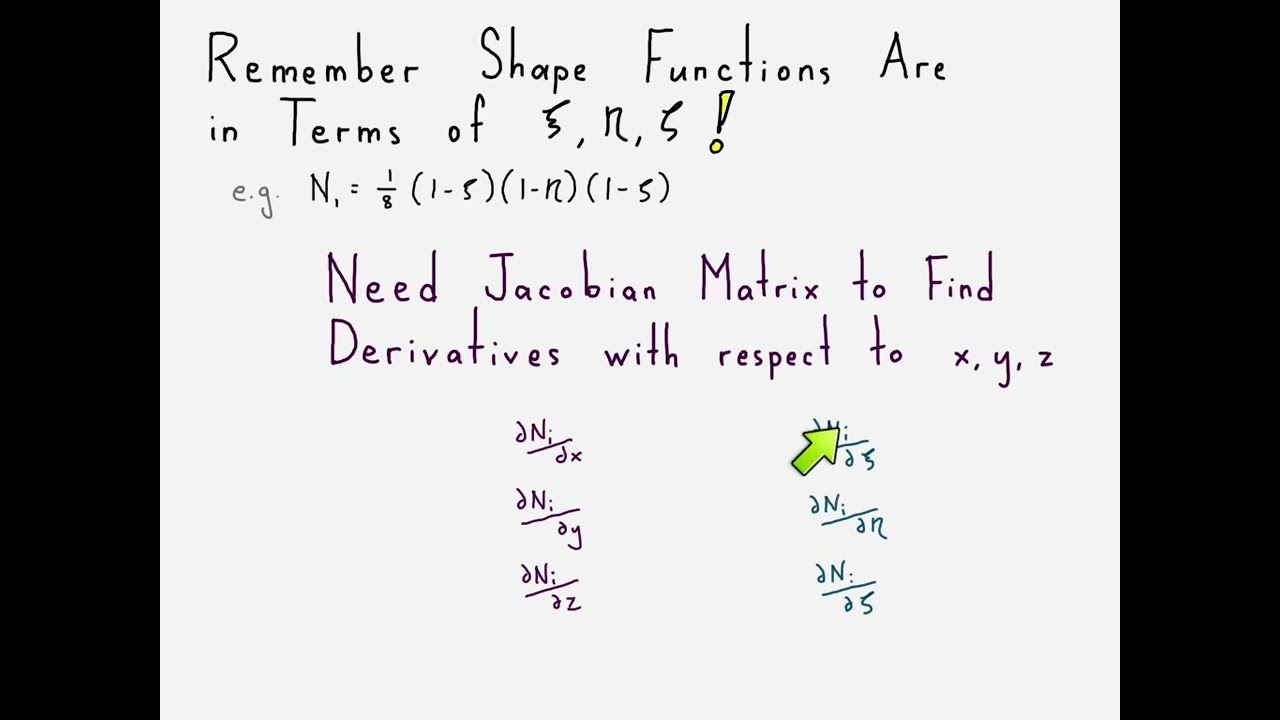
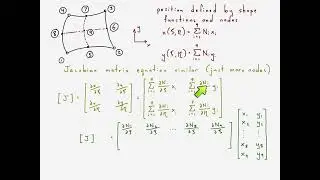
This video gives an overview of 8-node linear isoparametric hexahedral elements in FEA. It shows how this element is similar in form to the 4-node linear isoparametric quadrilateral element. The video covers displacement functions, shape functions, stiffness matrix formation, stress evaluation, and some practical guidelines.
0:00 - Introduction and comparison with isoparametric quadrilateral element
2:14 - Displacement functions and shape functions
5:07 - Jacobian matrix
6:46 - Stiffness matrix overview
7:45 - 3D Stress element and constitutive matrix
9:25 - Strain equations and strain displacement matrix
12:17 - Gauss quadrature for integrating stiffness matrix equation
13:49 - Stress evaluation
16:36 - Summary with benefits and concerns
19:47 - Reflection questions
Suggested answers to reflection questions:
1.) Solid elements are 3D elements in 3D space. When the element dimension is the same as the space it occupies, rotational stiffness is unnecessary. If you imagine two cubes connected at each of the four corners, the cubes would not be able to freely rotated about any corner or edge. However, for elements like shells that are 2D but exist in 3D space, bending stiffness is necessary. If two shell elements are connected at an edge, the elements would freely rotate about that edge if rotational stiffness was not present.
2.) The big concern is having an unintended mechanism such as a hinge present. Please see 18:38 for more information.
3.) The big differences in the stiffness matrix formulation for an 8-node hexahedral element vs. a planar 4-node quadrilateral are:
Integration in a third natural coordinate direction, zeta
Jacobian matrix, [J], is now 3x3 to account for the three physical coordinates (x, y, z) and the three natural coordinates (xi, eta, zeta).
Constitutive matrix, [C], is now 6x6 to account for the six possible stresses and strains in 3D space.
Strain-Displacement matrix, [B], is now 6x24 to account for six possible strains and 24 degrees of freedom in a solid element
Gauss Quadrature occurs in three dimensions instead of two (8 total Gauss points)
Доступные форматы для скачивания:
Скачать видео mp4
-
Информация по загрузке:


![Мозаика Пенроуза, бесконечная и неповторимая [Veritasium]](https://image.4k-video.ru/id-video/gqlnXRxV32o)


