How to Achieve Customized Output in Python with chr() Function
Автор: vlogize
Загружено: 2025-09-06
Просмотров: 1
Learn how to modify your Python code to produce desired outputs using the `chr()` function. Get tips on coding with examples for better understanding.
---
This video is based on the question https://stackoverflow.com/q/63212406/ asked by the user 'Minal' ( https://stackoverflow.com/u/14031825/ ) and on the answer https://stackoverflow.com/a/63212633/ provided by the user 'ismailfarisi' ( https://stackoverflow.com/u/14035792/ ) at 'Stack Overflow' website. Thanks to these great users and Stackexchange community for their contributions.
Visit these links for original content and any more details, such as alternate solutions, latest updates/developments on topic, comments, revision history etc. For example, the original title of the Question was: Python get data in this format
Also, Content (except music) licensed under CC BY-SA https://meta.stackexchange.com/help/l...
The original Question post is licensed under the 'CC BY-SA 4.0' ( https://creativecommons.org/licenses/... ) license, and the original Answer post is licensed under the 'CC BY-SA 4.0' ( https://creativecommons.org/licenses/... ) license.
If anything seems off to you, please feel free to write me at vlogize [AT] gmail [DOT] com.
---
Achieving Customized Output in Python with chr() Function
When working with Python, sometimes the output we get does not quite fit our expectations. For instance, you may find yourself needing to adjust the sequence of outputs based on certain conditions. This guide addresses a common situation where the desired output format of a simple Python program needs to be modified for clarity and purpose.
The Problem
Let’s start by breaking down the scenario. You were given the following code:
[[See Video to Reveal this Text or Code Snippet]]
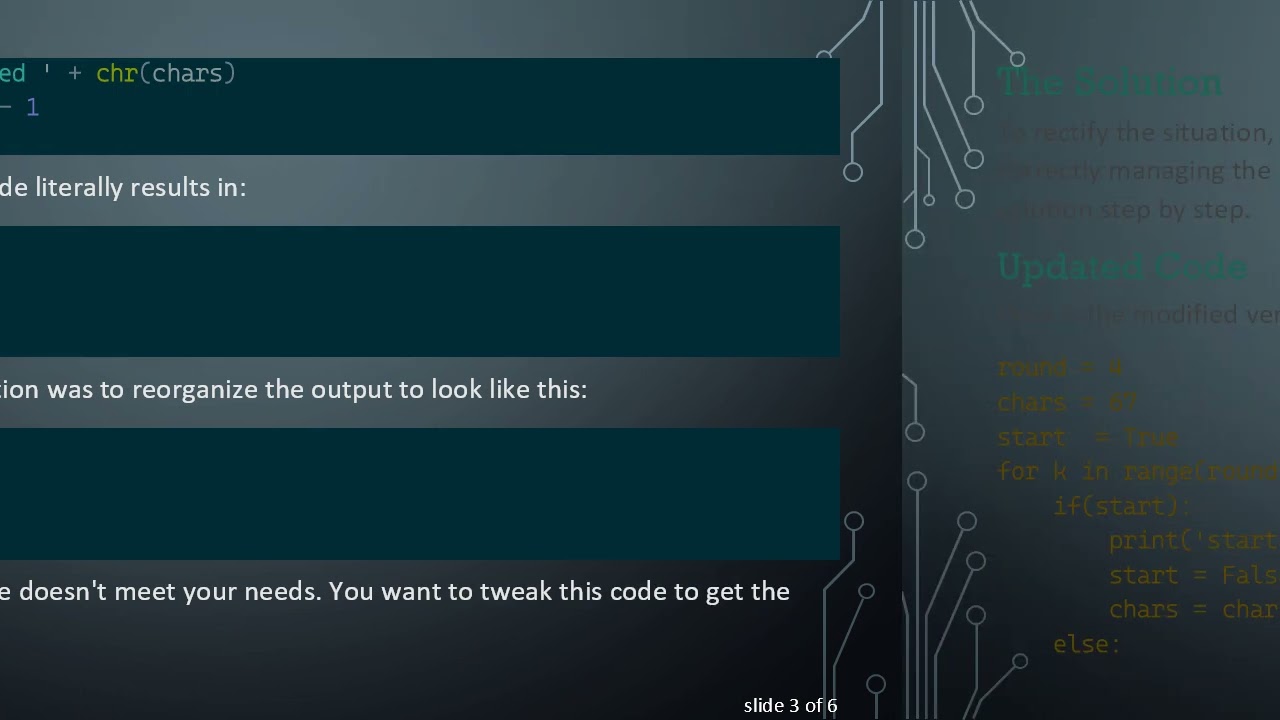
The output from this code literally results in:
[[See Video to Reveal this Text or Code Snippet]]
However, your expectation was to reorganize the output to look like this:
[[See Video to Reveal this Text or Code Snippet]]
Clearly, the original code doesn't meet your needs. You want to tweak this code to get the desired output format.
The Solution
To rectify the situation, we will need to make some adjustments in the code. The key lies in correctly managing the chars variable and the order of printing. Let's break down the solution step by step.
Updated Code
Here is the modified version of your initial code that will generate the required output:
[[See Video to Reveal this Text or Code Snippet]]
Explanation of Changes
Character Index Adjustment: The chars variable had to be set to 67 instead of 68 to start from C instead of D. This adjustment is crucial because the chr() function converts an ASCII value to its corresponding character.
Using a Toggle Variable: A boolean named start is utilized to toggle between starting and reaching. This helps control when to print "Start" or "Reached" as you iterate through the rounds.
Expected Output
Running the modified code will yield the desired result:
[[See Video to Reveal this Text or Code Snippet]]
Conclusion
By understanding how to manipulate variables and the flow of your code, you can customize your output effectively. This provides a clear pathway for not just solving similar problems but also enhancing your overall Python programming skills.
Whether you're a beginner or someone looking to brush up on Python coding, mastering these small tweaks can lead to significantly improved results. Don't hesitate to explore your appetite for coding by delving further into Python's capabilities!
Доступные форматы для скачивания:
Скачать видео mp4
-
Информация по загрузке:
![Курс Python с Абсолютного нуля! [12 часов из 80] Python курс - качественный старт для начинающих!](https://image.4k-video.ru/id-video/lYMLLI-MJek)

![Python - Полный Курс по Python [15 ЧАСОВ]](https://image.4k-video.ru/id-video/cfJrtx-k96U)