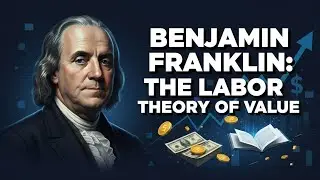
Episode 4: The 1739 Currency Act - Creating Value from Thin Air | Benjamin Franklin
Автор: MoniLytics: Financial Research
Загружено: 2026-01-03
Просмотров: 175
📜 Episode 4: The 1739 Currency Act - Creating Value from Thin Air | Benjamin Franklin
🔬 MoniLytics: Where Money Meets Research
👉 In 1739, the American colonies faced a crippling shortage of gold and silver. Benjamin Franklin didn't just see a problem; he saw an opportunity to redefine economic value.
This video explores how Franklin’s theories on paper currency and the "Labor Theory of Value" laid the groundwork for modern banking and even mirrors how we fund massive infrastructure like offshore wind today.
💸 Franklin’s Monetary Revolution: The Labor Theory of Value:
Before the dollar was a global reserve, Franklin had to convince the public that paper had real worth. He famously argued that the true measure of value wasn't gold, but labor.
Money as a Utility: Franklin viewed currency not as a hoard of wealth, but as a tool to facilitate trade. If there wasn't enough "medium of exchange," the economy would stall.
The Electricity Connection: Interestingly, Franklin often used the same mental models for finance as he did for science. He used monetary analogies to describe the flow of electricity, viewing both as "fluids" that needed to be balanced and directed to perform useful work.
The 1739 Currency Act: This period marked a fierce debate over "creating value from thin air." Franklin’s advocacy for paper money helped the colonies bypass the scarcity of British coins, effectively using governance to stimulate growth.
🌬️ From Printing Presses to Wind Turbines: Bankability & Risk:
The research suggests a surprising link between Franklin’s "created value" and the modern Offshore Wind Industry. Both rely on making a high-risk concept "bankable."
Complex Adaptive Systems: Just as Franklin had to build a network of trust for paper money, the offshore wind sector acts as a complex adaptive system. It isn't driven by "neutral markets" but by networked learning.
Strategic Investment: Emerging technologies—whether a new currency in 1739 or a wind farm in 2025—require state-owned investors and strategic banks to build the "investment know-how" that private markets initially fear.
Deliberate Governance: Sustainable transitions are never accidental. Franklin’s success with currency and the modern success of renewable energy both prove that collective experience and institutional support are what make a technology cost-competitive.
📈 The MoniLytics Perspective: The "Networked Learning" of Wealth:
Value is Social: Franklin understood that money only has value if the network agrees it does. This is the same principle that allows "Green Bonds" or "Carbon Credits" to fund the energy transition today.
The Knowledge Premium: The "know-how" gained by early adopters of Franklin’s currency—and today’s wind pioneers—creates a competitive advantage that is more valuable than the physical assets themselves.
📚 Recommended Reading (Deepen Your Research - Affiliate Links):
Explore how economic theories and institutional governance shape our world with these top resources.
📖 "The Nature of Value" by Nick Gogerty: A modern look at how we define and create value in complex systems, echoing Franklin's original theories. [https://amzn.to/4jbXsfB]
📖 "Benjamin Franklin: An American Life" by Walter Isaacson: A deep dive into Franklin's scientific and economic genius. [https://amzn.to/3MLPBZT]
🎧 Try Audible: Get a 30-day FREE trial—perfect for listening to historical biographies and economic research on the go. [https://www.amazon.co.uk/hz/audible/m...]
#️⃣ Keywords & Hashtags:
#BenjaminFranklin #CurrencyAct #EconomicTheory #LaborTheoryOfValue #OffshoreWind #RenewableEnergy #Bankability #HistoryOfMoney #MoniLytics
🔔 Subscribe to MoniLytics for more videos where research illuminates financial decisions! ✨

Доступные форматы для скачивания:
Скачать видео mp4
-
Информация по загрузке: