Episode 5: The Labor Theory of Value - Human Effort as Currency | Benjamin Franklin
Автор: MoniLytics: Financial Research
Загружено: 2026-01-07
Просмотров: 8
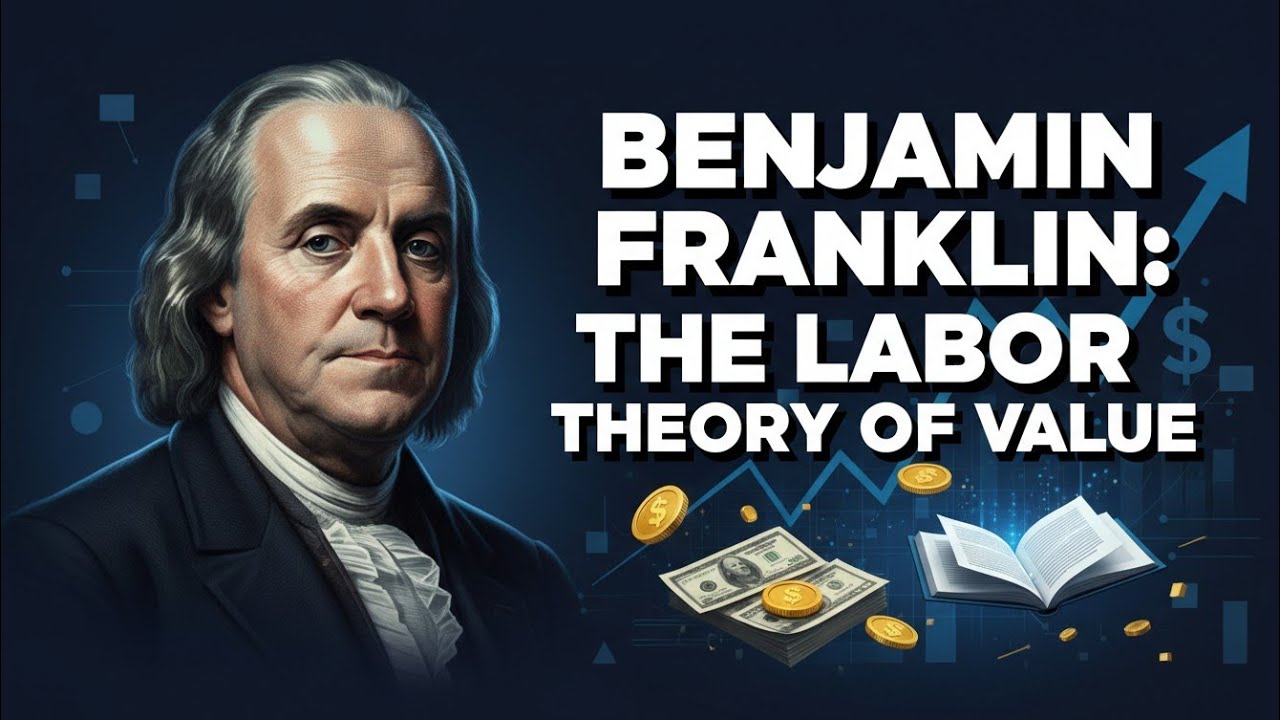
📜 Episode 5: The Labor Theory of Value - Human Effort as Currency | Benjamin Franklin
🔬 MoniLytics: Where Money Meets Research
👉 In this episode, we explore Benjamin Franklin’s revolutionary perspective on what makes a dollar actually "valuable." By shifting the focus from gold to human effort, Franklin didn't just help a young nation survive—he anticipated the massive labor movements and economic theories that would define the next two centuries.
🛡️ Franklin’s Financial Firewall: Graphite and Counterfeiting
Before Franklin could implement his "Labor Theory of Value," he had to solve a technical problem: trust. If paper money could be easily faked, its value would vanish.
Technological Security: Franklin pioneered the use of graphite-based ink and unique "nature printing" (using actual leaf impressions) to create a physical security layer for early American currency. This was the 18th-century version of a blockchain—a way to verify the authenticity of value.
The "Labor Theory" Origins: Franklin argued that the value of an object—including money—should be measured by the labor required to produce it.
✊ The Evolution of Value: From Franklin to Marx
Franklin’s early ideas acted as a bridge to the 19th-century labor movements that transformed the world.
Class Conflict and Industrialization: As industrial capitalism took hold, the "Labor Theory of Value" became the intellectual bedrock for Karl Marx and Friedrich Engels. They expanded on the idea that labor was being exploited by the capitalist class, leading to the formation of the International Working Men's Association.
The Struggle for Rights: The documents chronicle a shift from Franklin’s focus on currency stability to the proletarian struggle for basic rights, including political strikes and the push for shorter workdays.
Internal Frictions: The movement wasn't a monolith; it was defined by internal conflicts, such as the ideological battles between the Marxist wing and the Bakuninist factions, who debated whether the state should be reformed or abolished entirely.
💻 The MoniLytics Perspective: Labor in the Digital Age
How does the 18th-century printer’s logic hold up in a world of automation and AI?
The Return to "Proof of Work": In many ways, modern cryptocurrencies mirror Franklin’s security concerns. Just as he used graphite and unique prints to secure value, digital assets use computational "labor" to secure their networks.
The Value of Effort: As AI lowers the cost of "output," we are returning to Franklin’s original question: If a machine does the work, where does the value come from? Research suggests that human-centric labor and specialized "know-how" are becoming the new scarce currencies.
📚 Recommended Reading (Deepen Your Research - Affiliate Links):
Explore the origins of value and the history of labor movements with these essential texts.
📖 "Capital: Volume 1" by Karl Marx: The definitive expansion on the Labor Theory of Value and the critique of industrial capitalism. [https://amzn.to/44GCXS9]
📖 "The First American: The Life and Times of Benjamin Franklin" by H.W. Brands: A comprehensive look at Franklin’s role in shaping the American economy. [https://amzn.to/3MYohaR]
🎧 Try Audible: Get a 30-day FREE trial—perfect for listening to historical biographies and economic research on the go. [https://www.amazon.co.uk/hz/audible/m...]
#️⃣ Keywords & Hashtags:
#BenjaminFranklin #LaborTheoryOfValue #EconomicHistory #KarlMarx #LaborMovements #Capitalism #HistoryOfMoney #FinancialSecurity #MoniLytics
🔔 Subscribe to MoniLytics for more videos where research illuminates financial decisions! ✨
Доступные форматы для скачивания:
Скачать видео mp4
-
Информация по загрузке: