Capital Leases in Enterprise Value: Why You Should Add Them
Автор: Mergers & Inquisitions / Breaking Into Wall Street
Загружено: 2017-01-09
Просмотров: 14797
In this tutorial, you’ll learn why it’s best to add Capital Leases when moving from Equity Value to Enterprise Value, and why it makes your life much easier when calculating valuation metrics and multiples.
http://breakingintowallstreet.com/
"Financial Modeling Training And Career Resources For Aspiring Investment Bankers"
Table of Contents:
2:09: Operating vs. Capital Leases
4:21: Valuation Multiples and Leases
9:24: Recap and Summary
Some people have disagreed with our treatment of Capital Leases, where we add them when moving from Equity Value to Enterprise Value.
They argue that we should NOT Capital Leases when calculating Enterprise Value because they are operational in nature and do not represent a long-term funding source or different investor group.
You can make a case for this treatment, but from a practical perspective, you pretty much have to add Capital Leases to get consistent valuation multiples.
If you do NOT add them, you’ll have to make further adjustments to metrics such as EBITDA and EBIT when using them in valuation multiples, which may or may not be viable.
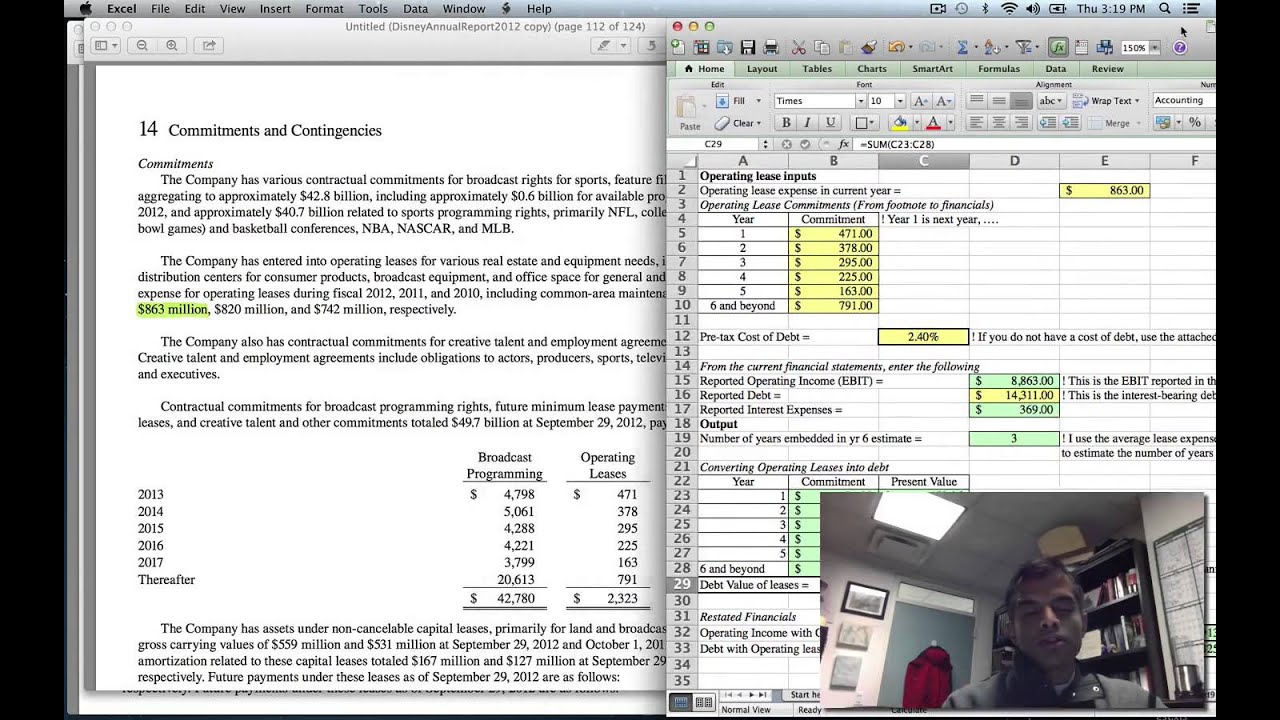
Operating vs. Capital Leases
With an operating lease, the company simply rents an asset and records a rental expense under its Operating Expenses on the Income Statement. There is no ownership.
With a capital lease, the company records the asset under PP&E on its Balance Sheet and records the lease as a liability on the L&E side.
It also records Depreciation on the asset and Interest Expense on the Capital Lease on its Income Statement.
The Problem
If you INCLUDE a Balance Sheet item in the numerator of a valuation multiple, you EXCLUDE the corresponding expense in the denominator.
“Exclude” means that you leave it out if it hasn’t yet affected the denominator, or that you add it back if it has.
The opposite applies if you have EXCLUDED a Balance Sheet item in the numerator.
For example, Debt is included in Enterprise Value, so in the EV / EBIT and EV / EBITDA multiples, you exclude the corresponding Interest Expense in the denominator (EBIT or EBITDA).
If you add Capital Leases when calculating Enterprise Value, as we’ve suggested before, you don’t have to do anything special.
By definition, EBITDA already excludes ALL Depreciation and Interest, so it also excludes the Depreciation and Interest from Capital Leases.
This is consistent with adding them to Enterprise Value: You’ve added them in the numerator and excluded the corresponding expenses in the numerator.
But if you do NOT add Capital Leases in the numerator, then you need to adjust EBITDA so that it INCLUDES Depreciation and Interest from Capital Leases.
In other words, you have to SUBTRACT OUT only the portion of Interest and Depreciation associated with Capital Leases from EBITDA.
You end up with some new metric like “EBITDA Adjusted for Capital Leases” (or whatever you want to call it).
Not only is this confusing, but most companies don’t even disclose enough information to do it.
Many firms group together all the expenses for capital leases, and many do not break out Interest and Depreciation from different sources separately.
So, we recommend keeping this concept VERY simple and adding Capital Leases when moving from Equity Value to Enterprise Value.
It has nothing to do with whether or not they’re “financial” or “operational” in nature, but rather a practical consideration: It’s difficult and error-prone to adjust EBITDA (and other metrics) if you do NOT add Capital Leases.
You should use standard metrics that everyone is familiar with and avoid non-standard metrics that require footnotes and explanations.
RESOURCES:
https://youtube-breakingintowallstree...
https://youtube-breakingintowallstree...

Доступные форматы для скачивания:
Скачать видео mp4
-
Информация по загрузке:




![Working Capital and the Change in Working Capital in Valuation and Financial Modeling [REVISED]](https://imager.clipsaver.ru/tMgty8jwmHI/max.jpg)

![US GAAP vs. IFRS in Valuation and Financial Modeling [REVISED]](https://imager.clipsaver.ru/jFplsqw3vG0/max.jpg)