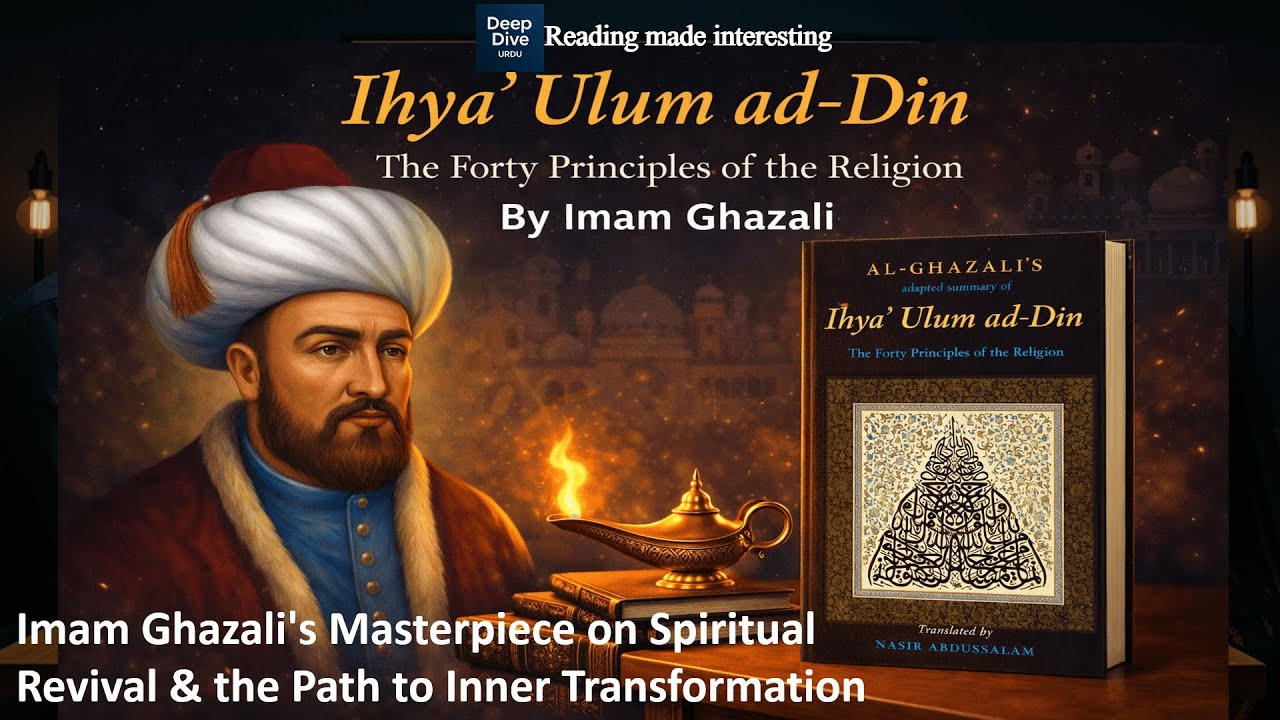
Ihya Ulum al-Din By Imam Ghazali | The Forty Principles of the Religion
Автор: Deep Dive Urdu
Загружено: 2025-12-17
Просмотров: 505
Ihya Ulum al-Din: The Revival of Religious Sciences by Imam Abu Hamid Al-Ghazali
In this comprehensive video, we explore one of the most influential spiritual and philosophical works in Islamic history—Ihya Ulum al-Din (The Revival of the Religious Sciences), authored by the legendary 11th-century scholar Imam Abu Hamid Al-Ghazali.
Understanding the Genesis of a Masterpiece
Imam Ghazali authored this monumental work during one of the most profound periods of his life—a period marked by spiritual crisis and intellectual transformation. At the peak of his fame, serving as the head of the prestigious Nizamiyya University in Baghdad, Ghazali experienced a deep spiritual awakening that compelled him to abandon his prestigious position and embark on a journey of self-discovery. His travels through Damascus, Jerusalem, and finally to Mecca became a transformative pilgrimage that culminated in the creation of what many scholars consider the second most important book in Islamic civilization after the Qur'an itself.
The Scope and Structure of the Work
The original Ihya spans forty volumes and is organized into four major sections, each containing ten chapters—a structure that mirrors both theological depth and pedagogical accessibility. This is not merely a book of jurisprudence; rather, it is a comprehensive encyclopaedia addressing every dimension of Muslim life: beliefs, worship, social interactions, moral character, spiritual development, and the inner purification of the soul.
The Four Quarters Explained
The first quarter, Al-Ibada (Acts of Worship), begins with an entire chapter devoted to the virtue of knowledge itself. This section covers the foundational pillars: ritual purity, prayer, charity, fasting, pilgrimage, and the recitation of the Qur'an. However, Ghazali transcends mere legal compliance; he explores the spiritual mysteries and inner dimensions of each practice, demonstrating how external rituals become pathways to divine proximity.
The second quarter focuses on Adab (Social Ethics and Manners), examining how believers should conduct themselves in worldly affairs—eating and drinking with propriety, maintaining marital harmony, earning livelihood lawfully, cultivating genuine friendships, and embodying the prophetic character. Here, Ghazali demonstrates that spirituality is not an escape from society but rather an ethical framework for living meaningfully within it.
The third quarter, Al-Muhlikat (Destructive Vices), confronts the psychological and spiritual diseases of the soul that humans must overcome—greed, lust, pride, envy, anger, miserliness, ostentation, and vanity. Ghazali employs what scholars recognize as an early form of religious psychology, systematically analyzing how these vices corrupt not only individual character but social harmony.
The fourth and final quarter, Al-Munjiyat (Saving Virtues), presents the path to spiritual elevation through virtues such as repentance, patience, gratitude, fear of God, hope, poverty, asceticism, the unity of God, love, sincerity, self-examination, meditation, and ultimately, remembrance of death. This closing section serves as a powerful meditation on mortality, bringing the reader full circle to a profound understanding of human purpose.
Bridging Law and Spirituality: The Revolutionary Integration
What distinguishes Ihya Ulum al-Din from purely juridical works is Ghazali's revolutionary synthesis of Fiqh (Islamic jurisprudence) with Tasawwuf (Islamic mysticism or Sufism). Before Ghazali, these two intellectual traditions were often viewed as incompatible—one emphasizing outward compliance, the other inner spiritual experience. Ghazali demonstrated that authentic Islam requires both: the correct outward performance of religious obligations united with sincere inner purification and spiritual intention.
This integration was transformative. Ghazali proved that Sufism, with its emphasis on personal spiritual experience and direct knowledge of God, could harmoniously coexist with orthodox Islamic theology and law. His work effectively elevated Sufism from a marginalized practice to a central component of mainstream Islamic learning.
The Philosophical and Theological Innovation
#IhyaUlamAlDin #ImamGhazali #IslamicSpirituality #RevivalOfReligiousSciences #IslamicPhilosophy #SufiPath #SpiritualTransformation #IslaimicWisdom #BookSummary #IslamicScholarship #AbuHamidAlGhazali #SpiritualGrowth #IslamicTeachings #InnerPurification #IslamicEthics #Tawheed #SufiMysticism #IslamicHistory #ReligiousSciencies #SpiritualJourney
Доступные форматы для скачивания:
Скачать видео mp4
-
Информация по загрузке: