C4 CYCLE
Автор: Neural Academy
Загружено: 2018-01-11
Просмотров: 276086
• Photosynthesis: Light-dependent/independen...
^ Photosynthesis
Why do C3 plants, such as wheat, thrive in climates that are wet and cold, while C4 plants, such as maize, have the advantage in hotter, drier climates?
Well, as mentioned in this video, RuBisCo sometimes binds oxygen instead of carbon dioxide. This wasteful alternative pathway is called photorespiration.
Here’s a brief overview of RuBisCo’s actions:
In the Calvin cycle, CO2 is combined with RuBP to form two PGAs. Upon the completion of 6 rounds of this cycle, one glucose molecule can be produced.
Sometimes, however, RuBisCo picks up oxygen instead. This results in photorespiration. The oxygen is combined with RuBP and creates only one PGA, as well as phosphoglycolate, a two carbon molecule that is toxic to plants. This is why photorespiration is sometimes called the C2 cycle.
Following the creation of phosphoglycolate, the plant attempts to reduce negative consequences, and is forced to use up precious ATP and NADPH that was created during the light-dependent reactions.
As a result, photorespiration decreases the net CO2 converted to sugars and decreases the plant’s growth rate.
To minimize photorespiration, plants need to keep oxygen concentrations low in their leaves. Plants accomplish this by keeping their stomata open.
Stomata are pores in the leaf epidermis that facilitate gas exchange. This is how oxygen leaves and CO2 enters. However, open stomata also result in a process called transpiration.
Transpiration is the movement of water through the plant and its subsequent evaporation.
Most of the water taken up by a plant’s roots is lost in this fashion. Stomata are more numerous on the undersides of leaves to limit this.
Transpiration isn’t totally a bad thing, as evaporation of water from exposed plant surfaces results in water rising from the roots, thanks to an osmotic process called transpiration pull, allowing for mass flow of mineral nutrients along coming along with the water.
In a cold, wet climate, where water loss isn’t as much of a concern, keeping stomata open isn’t a problem. Here, C3 plants thrive.
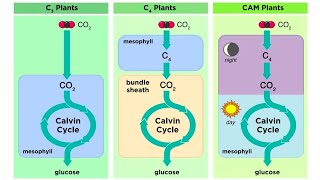
However, in hotter, drier climates, where water loss through transpiration is less affordable, C4 plants have the advantage. Here, it is worth investing into an adaptation called “Kranz Anatomy. This adaptation, while inefficient in a cold, wet climate, allows these plants to flourish in harsher conditions. Let’s compare a cross section of a C3 and C4 plant leaf.
Both have an upper and lower epidermis, as well as stomata. C3 plants have two types of mesophyll cells that carry out different functions: palisade mesophyll cells, and spongy mesophyll cells. Meanwhile, C4 plants don’t have this specialization. Both C3 and C4 plants have bundle sheath cells, which surround the vascular bundles.
In this video, we shall focus on how the C4 anatomy counters the problem of photorespiration.
Let’s look at the C4 pathway, also called the HSK or hatch slack kortshak pathway.
Again, this pathway takes place in C4 plants, specifically in the mesophyll and bundle sheath cells. Let’s zoom in on these cells. The reactions take place within their chloroplasts.
We start off in the chloroplast of the mesophyll cell, with PEPA, or phosphoenolpyruvate, which is a three carbon molecule, CO2, and PEP Carboxylase. PEP carboxylase adds the CO2 onto the PEPA, and the result is OAA, or oxaloacetate. This is the first stable compound in the pathway. It has 4 carbons, and this is why this pathway is called the C4 cycle. You may recall that the first stable compound in the C3, or Calvin, cycle is 3 carbons.
Next, the reducing agent NADPH2 comes in and reduces OAA to Malic Acid. Malic Acid then travels to the chloroplast of the bundle sheath cell, where a decarboxylase removes the CO2. This is the plant’s ultimate agenda, for now, within the chloroplasts of the bundle sheath cells, so carefully guarded from the presence of oxygen by the concentric ring of mesophyll cells surrounding them, RuBisCo is flooded with basically pure CO2, with no oxygen to confuse it. The CO2 enters the Calvin cycle within the chloroplasts of the bundle sheath cells, and the C4 plant has successfully bypassed photorespiration!
Pyruvic acid is the three carbon compound that remains after the CO2 is stripped off of Malic acid. It diffuses back into the chloroplast of the mesophyll cell. Here, ATP phosphorylates it, turning it back into the original compound, PEPA.
Credits: Video Copilot textures

Доступные форматы для скачивания:
Скачать видео mp4
-
Информация по загрузке: