Resolving the mutating table Error in SQL Triggers
Автор: vlogize
Загружено: 2025-08-21
Просмотров: 0
Learn how to effectively use SQL triggers to automatically update columns in a table on insert or update actions. This guide explains the `mutating table` error and provides a straightforward solution.
---
This video is based on the question https://stackoverflow.com/q/64071977/ asked by the user 'Han' ( https://stackoverflow.com/u/6140795/ ) and on the answer https://stackoverflow.com/a/64072013/ provided by the user 'GMB' ( https://stackoverflow.com/u/10676716/ ) at 'Stack Overflow' website. Thanks to these great users and Stackexchange community for their contributions.
Visit these links for original content and any more details, such as alternate solutions, latest updates/developments on topic, comments, revision history etc. For example, the original title of the Question was: trigger to update specific column when insert/update happened in same table
Also, Content (except music) licensed under CC BY-SA https://meta.stackexchange.com/help/l...
The original Question post is licensed under the 'CC BY-SA 4.0' ( https://creativecommons.org/licenses/... ) license, and the original Answer post is licensed under the 'CC BY-SA 4.0' ( https://creativecommons.org/licenses/... ) license.
If anything seems off to you, please feel free to write me at vlogize [AT] gmail [DOT] com.
---
Resolving the mutating table Error in SQL Triggers: A Simple Solution
When working with databases, encountering issues with triggers is not uncommon. One such issue often faced by developers is the mutating table error in SQL. This occurs when you attempt to perform an action on a table that is currently undergoing changes due to an insert or update operation. In this guide, we will explore how to approach the problem of updating a specific column within the same table during insert or update operations, and we will provide a clear solution using triggers.
Understanding the Problem
Imagine you are managing a user database where you need to automatically update a column based on a user's email domain whenever a new user is added or an existing user's email is updated. This is a common requirement, but implementing it with SQL triggers can sometimes lead to headaches.
Example Scenario
You have the following SQL operation:
[[See Video to Reveal this Text or Code Snippet]]
After this insert, you want the ORG column to automatically update to 'market' for the user with ID = '1'. However, if you try to perform this update within a trigger, you may encounter the following error message:
[[See Video to Reveal this Text or Code Snippet]]
This indicates that the trigger is attempting to modify a table that is already in the process of being modified, creating a conflict.
The Solution: Use BEFORE Triggers
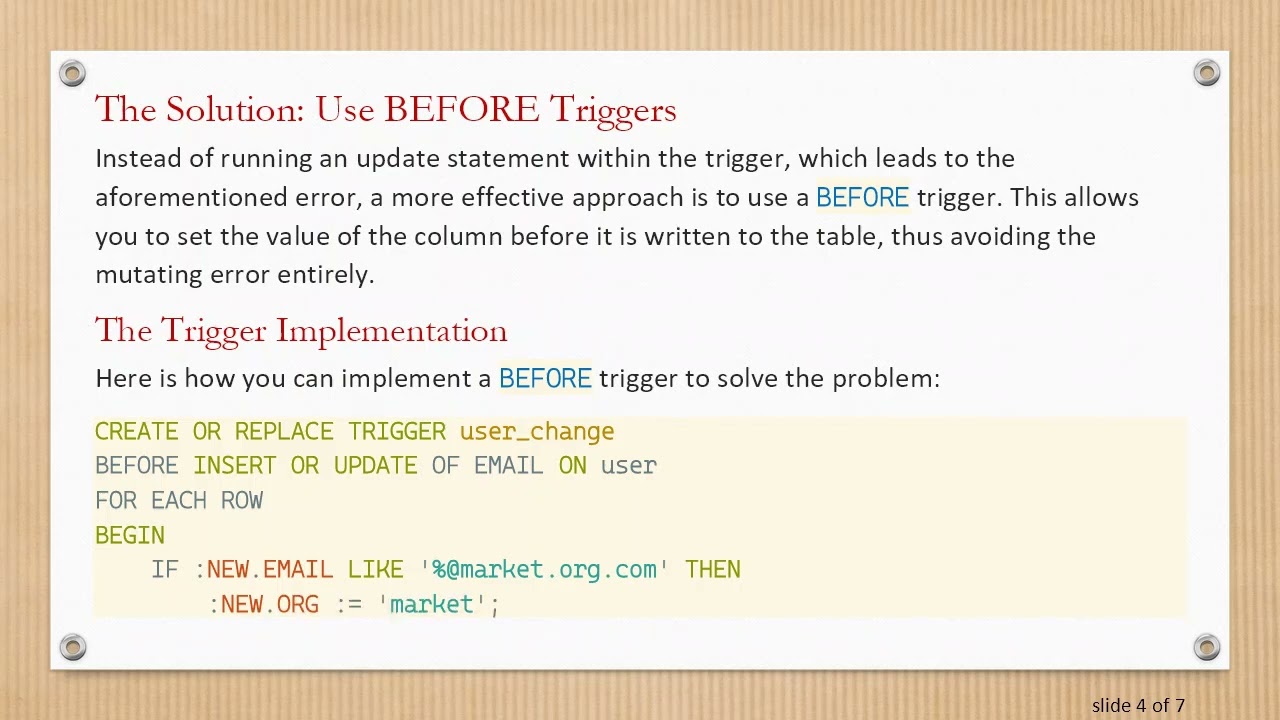
Instead of running an update statement within the trigger, which leads to the aforementioned error, a more effective approach is to use a BEFORE trigger. This allows you to set the value of the column before it is written to the table, thus avoiding the mutating error entirely.
The Trigger Implementation
Here is how you can implement a BEFORE trigger to solve the problem:
[[See Video to Reveal this Text or Code Snippet]]
Explanation of the Code
Trigger Type:
BEFORE INSERT OR UPDATE OF EMAIL specifies that this trigger will fire before an insert or update action on the EMAIL column.
FOR EACH ROW:
This indicates that the trigger will act on each row being inserted or updated.
Condition Check:
IF :NEW.EMAIL LIKE '%@ market.org.com': This checks if the new email being inserted or updated matches the specified domain.
Setting the Value:
:NEW.ORG := 'market'; assigns the value 'market' to the ORG column for the affected row before it is written to the table.
Benefits of Using BEFORE Triggers
Avoids Mutating Table Issues: By manipulating the new values rather than running a separate update statement, you can sidestep the mutating table error.
Simplicity: The logic becomes more straightforward and encapsulated in one action, eliminating redundancies.
Performance: Reducing the need for multiple DML statements improves performance and decreases the complexity of your database operations.
Conclusion
Handling triggers in SQL can be tricky, especially when it comes to updating columns based on other field values. By using a BEFORE trigger to directly set the updated value of a column, you avoid common pitfalls such as the mutating table error. This approach simplifies your logic and enhances performance.
By incorporating this method into your database management, you can efficiently address similar challenges in the future and streamline your data operations. Happy coding!
Доступные форматы для скачивания:
Скачать видео mp4
-
Информация по загрузке: