Water Well Management – Industrial IoT Sensors Monitoring Groundwater Levels, Pumps, and Flow Meters
Автор: Valarm
Загружено: 2020-05-19
Просмотров: 988
Production Water Well Monitoring Systems Integrating Industrial IoT Sensors with https://Tools.Valarm.net
You probably know that water is a precious resource for you, your family, and all of us living here on this earth.
How do you effectively monitor water wells to make sure you’re efficiently and safely using water pumps, pipes, level sensors, and flow meters?
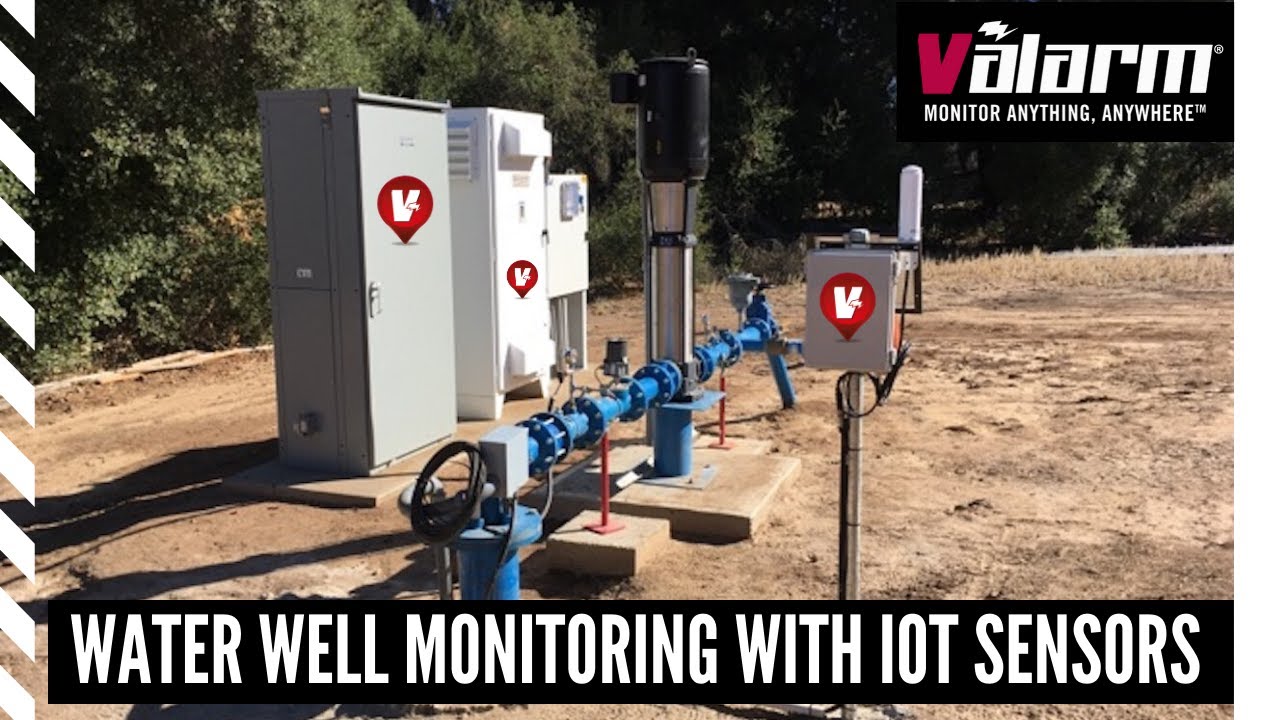
That’s just what we’ll be talking about in this here story – Water Management Systems. In the photos you’re seeing remote water monitoring systems deployed at water wells in California.
These water well monitoring systems automatically upload water sensor information to Tools.Valarm.net as often as you need it.
On Tools.Valarm.net, you, your teams, and your organization can map, graph, analyze, download, API forward, alert, and do anything else you need to do with your water monitoring systems.
What are Your Water Monitoring Systems made of?
Each of these water wells have the following 2 key sensors that are monitored in real-time with Tools.Valarm.net and Industrial IoT Web Dashboards:
Flow Meters – Flowmeters made by companies like McCrometer that output a pulse every X number of gallons, measured by a PWM sensor adapter
Water Level Sensors – Pressure transducers made by hardware manufacturers like In-Situ or Flowline that output 4-20 mA signals, which are translated into depths, in feet or meters, of water in the wells. Note that since Tools.Valarm.net is an open, flexible platform, your organization can also use ultrasonic, sonar, and other sensors made for wells that measure water levels, like sensors made by Senix and Eno Scientific.
Also inside of each of these water monitoring systems you’re seeing these hardware components:
Morningstar solar charge controllers (Sun Savers) that manage system power. Your charge controllers receive power from your solar panels and charge your backup batteries while distributing power to the other remote monitoring pieces.
Sensor hubs are the central brain units / CPUs that receive data from the sensor adapters and upload sensor measurements at regular time intervals, as often as you need, to Tools.Valarm.net. In these systems, you’re seeing 3G GSM sensor hubs that send sensor telemetry information via AT&T‘s mobile cell phone network. You can also use Ting, Verizon CDMA, T-Mobile, Ethernet, Ingenu, WiFi, or whichever internet connectivity makes the most sense for your monitoring network’s deployment locations.
4-20 mA sensor adapters read sensor measurements from pressure transducers / water level sensors. Note that some water level sensors output RS-232, 0-10V, or RS-485 sensor standard protocols, and that works just fine with Tools.Valarm.net as well.
PWM sensor adapters count pulses output by flow meters. Each tick, spin, or pulse represents a real world quantity, like 1 gallon per pulse, which is what you’ll use to make sense of your sensor measurements on Tools.Valarm.net and your web dashboards.
Volt sensors monitor system health. These record system voltage and how much juice your batteries have. They’ll quickly tell you if you need to upgrade to bigger solar panels or batteries, or if your systems are experiencing cloudier days than you thought they would. They’ll also confirm when your battery is getting old and needs to be replaced – every couple years or so.
Waterproof Cable Glands on each box allow wires and cables to come into the box from things like sensors and solar panels. Then the cable glands tighten down on the cable to protect the inside of the box from the elements, this weatherproofing keeps your precious monitoring systems running.
The Antenna Bulkheads allows your systems to attach to external antennas, the white antenna-looking pieces you’re seeing in the photos. If you’re in an area where GSM cell network coverage is sparse, you’ll want to consider adding these. If your network coverage is solid then you won’t need these.
In the bottom right of the boxes are your Sealed Lead Acid (SLA) Batteries connected to your solar charge controllers.
On your water well web dashboards (say that 1 10 times fast) you’ll see critical information about each of your water wells. You can click the name, map icon, location of any of your water well on your map to see more information:
Safety and Health of your Headroom for your Pumps – Is it ok? Is your water level at a safe level above the water pump?
Depth to Water
Water Above Sensor
Pump Rate – gallons per minute – How much fluid is flowing?
Your Latest Measurements of Pump Head Room
Totalizer – How many total gallons has your well pumped?
Historical Graphing to show relationship of Depth to Water vs. Pump Rate – How’s your groundwater? What’s your aquifer recharge rate? Are your water levels recovering healthily?
Whether you need to monitor water, noise, flood warning systems, structural health of bridges and infrastructure, levees, air quality gases like methane, or anything else, we’ll help you deploy effective monitoring systems.
Доступные форматы для скачивания:
Скачать видео mp4
-
Информация по загрузке: