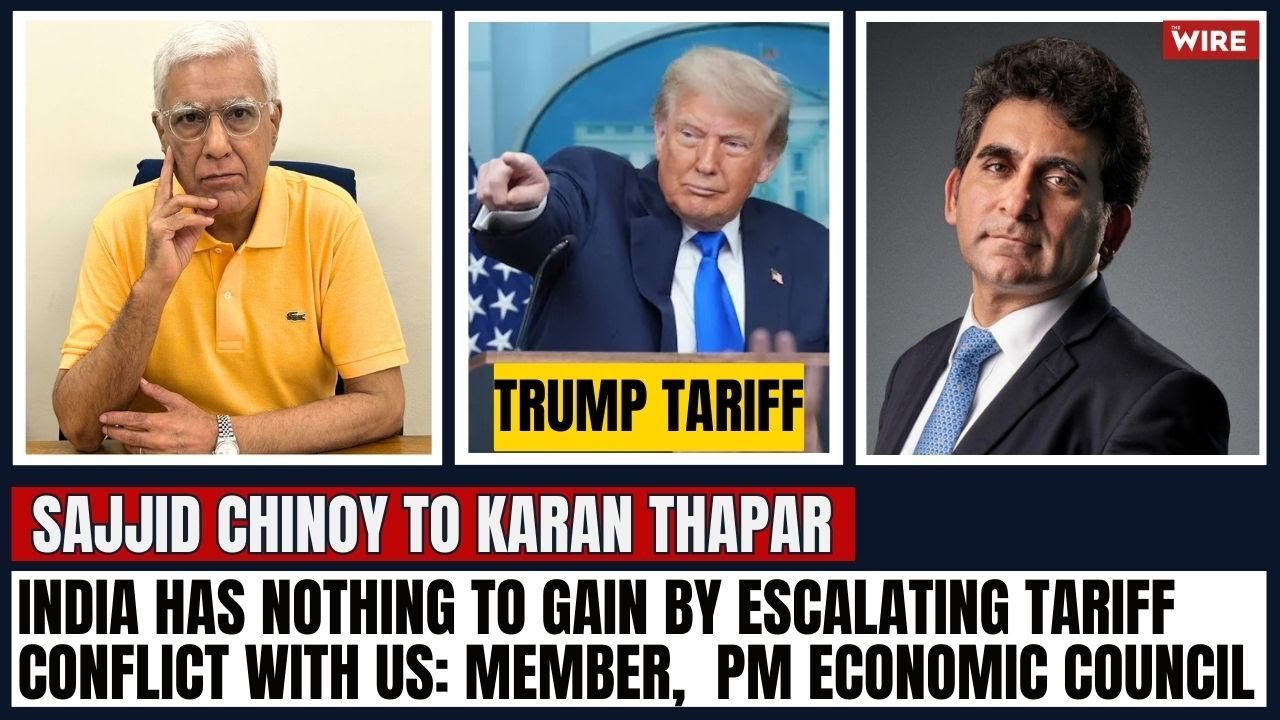
India has nothing to gain by escalating tariff conflict with US: Member, PM Economic Council
Автор: The Wire
Загружено: 2025-08-27
Просмотров: 79506
India has nothing to gain by escalating tariff conflict with US: Sajjid Chinoy, Managing Director & Chief India Economist of J. P. Morgan & Member PM Economic Advisory Council, to Karan Thapar for The Wire.
..........................................
A leading Member of the Prime Minister’s Economic Advisory Council, who is also Managing Director and Chief India Economist at J. P. Morgan Bank, Sajjid Chinoy, has said “India has nothing to gain by escalating the tariff war with the US.” Mr. Chinoy says that the government should follow the rule book established during the Covid pandemic and provide fiscal and monetary support to tide over the present difficult period faced by companies and sectors exporting to the United States.
Mr. Chinoy says he shares the belief expressed by Scott Bessent, the US Treasury Secretary, that sooner rather than later India and America will come together.
I will stop there. There’s a lot in this interview that you need to see and hear for yourself to understand how one of India’s leading economists views the present situation and the way it could develop and unfold.
To help you, I will give you the list of the questions asked. Here they are:
1) Yesterday Donald Trump’s threat of 50% tariffs was implemented. He’s suspended trade talks till the tariff dispute is resolved and says he doesn’t care if India’s dead economy sinks. Peter Navarro, the White House Counsellor for Trade, says the intention is to “hit India where it hurts”. Do you see this as a vindictive policy or is there some economic logic behind it?
2) Vice President Vance has said that 25% secondary tariffs have been imposed on India for importing Russian oil as “aggressive economic leverage” on Russia to stop the Ukraine war. Doesn’t that mean that India is collateral damage and President Trump doesn’t care what happens to India?
Navarro: “Modi’s war”, “Road to peace runs through New Delhi”.
3) If the object is “aggressive economic leverage” on Russia how come China, which imports more oil than India, has not had secondary tariffs imposed on it? In fact, in China’s case Marco Rubio has said its okay for China to keep importing Russian oil because that prevents inflation in global energy prices. Isn’t this double standards? Isn’t it one logic for China and another for India?
4) The question is what should India do? There seems to be two broad choices: first, India could grit its teeth and wait for better times, which so far seems to be what the Modi government is doing, or it could impose its own tariffs on America and thus resist and fight back. Which would you advise?
5) The problem is that India does not export anything to America that America can’t do without. In other words, unlike China, which has rare earth minerals, metals and magnets which America desperately needs, India doesn’t have similar leverage.
6) Let’s come to a second key issue. What do you believe will be the impact on the Indian economy of America’s 50% tariffs? First, tell me in terms of the exports that will suffer?
Garments, textiles, shrimps, diamonds and jewelry, leather goods, furniture, carpets.
7) The Global Trade Research Initiative estimates that 66% of India’s exports to the US will be hit with the 50% tariff. How significantly will this impact India’s $41 billion trade surplus with America?
Ajay Srivastava: India’s exports to US will fall from $86.5 billion in 2024-25 to around $50 billion in 2025-26 (TOI 27/8).
8) Dr. Rangarajan, the former Governor of the Reserve Bank, has estimated that this will reduce India’s GDP growth by around 0.6%. Would you agree?
9) These are very labour-intensive sectors of the Indian economy. So what would be the impact on jobs?
10) In the first instance, are there measures the Modi government can implement to ameliorate the tariff hit?
11) Let’s talk about the reciprocal tariffs. Can we afford to lower tariffs on American agricultural produce like corn and soya bean or American diary produce and thus ease the reciprocal tariffs?
12) Is this a point when India should seek to expand its trade agreements with other countries like the EU and join multilateral trade agreements that it’s earlier kept away from like the Regional Comprehensive Economic Partnership (RCEP) and the Comprehensive and Progressive Agreement for Trans-Pacific Partnership (CPTPP).
Join The Wire's Youtube Membership and get exclusive content, member-only emojis, live interaction with The Wire's founders, editors and reporters and much more. Memberships to The Wire Crew start at Rs 89/month. / @thewirenews
Доступные форматы для скачивания:
Скачать видео mp4
-
Информация по загрузке: