How an Equilibrium Constant varies with Temperature - Thermodynamics - Physical Chemistry
Автор: Casual Chemistry
Загружено: 2021-07-16
Просмотров: 4030
Deriving a quantitative relationship to show how an equilibrium constant varies with temperature and so showing were Le Chatelier's Principle comes from in this context. Along the way, the Gibbs-Helmholtz van't Hoff equations are derived and used.
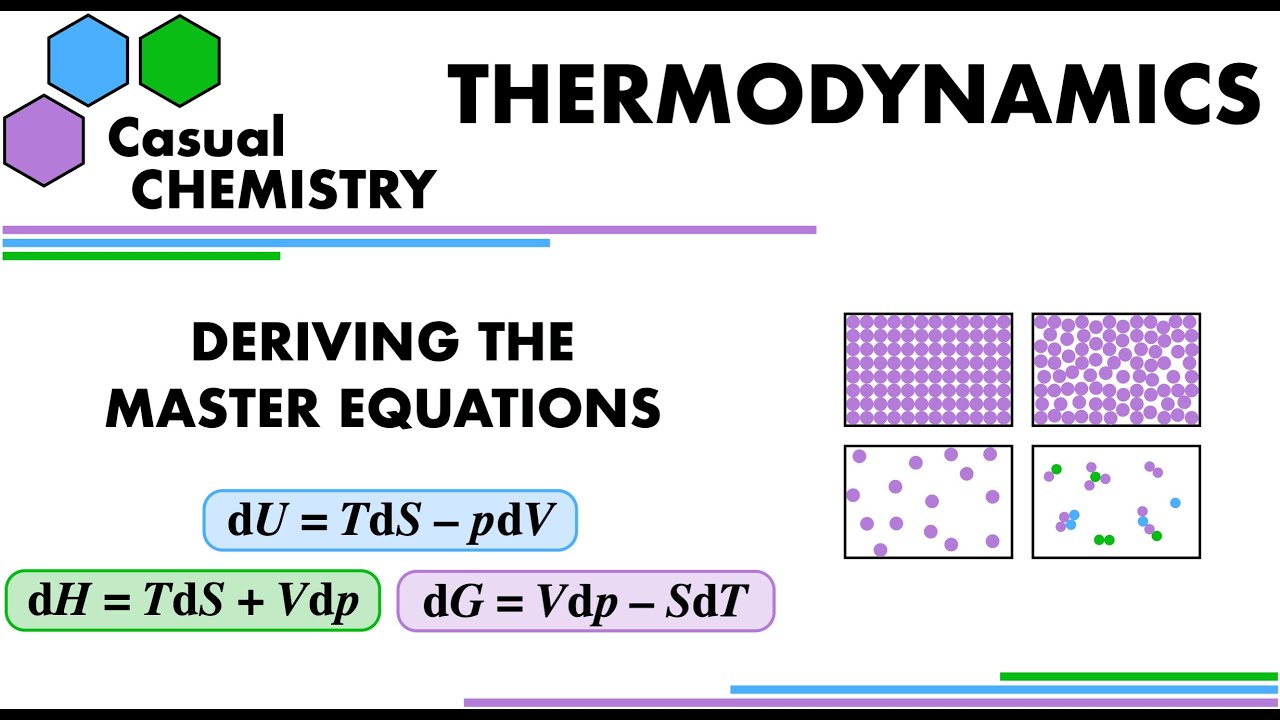
My video for deriving the thermodynamics Master Equations:
• Deriving the Thermodynamic Master Equation...
#chemistry #physics #physicalchemistry #pchem #thermodynamics #energetics #science #stem #learn #science #stemeducation #undergraduate
An equilibrium constant in chemistry is calculated from a formula (not proved here, future video perhaps) that comprised the multiplicative product of the concentrations of the reaction products (raised to their stoichiometric coefficients if appropriate) divided by the multiplicative product of the concentrations of the reactants (again raised to their stoichiometric coefficients if appropriate). All of these concentrations should be divided through by a relevant standard concentration (part of the mathematical derivation of what K actually is) and as such the equilibrium constant is always dimensionless. An equilibrium constant is always a specific value quoted for a specific temperature. This video explains how if you know what the equilibrium constant is for a certain temperature, you can work it our for a different temperature quantitatively (provided the other temperature that you're thinking of isn't massively far away from your quoted data book value).
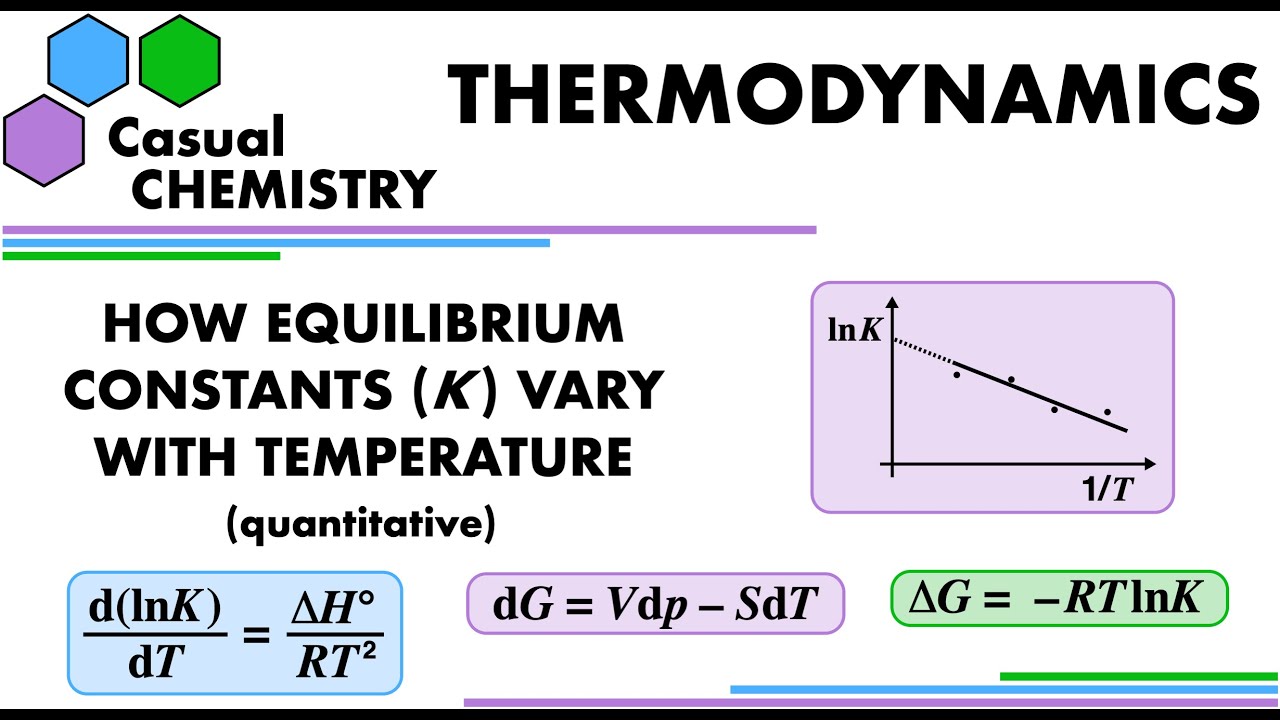
To get going with the thermodynamics, we need to use the definition of Gibbs energy for the reaction in question (as H-TS) as it is directly related to the enthalpy change and the entropy change for the reaction. The equation is also quite explicitly dependent on temperature. It is also well established (elsewhere) that the delta G (the change in Gibbs energy for a reaction/equilibrium) is equal to -RTlnK, where K is the equilibrium constant for the reaction. Both of these equations in combination show that there is a non-straightforward relationship between an equilibrium constant and the temperature that it is quoted at. To determine the mathematical relationship, we also need to use a thermodynamic Master Equation that tells us about infinitesimal changes in Gibbs energy (dG). A link to a video explaining how this is derived is at the top of this description). In the case of common chemical equilibria, they are known about in a constant pressure situation (dp = 0) and the energy changes associated with the reaction are described fully by an enthalpy change for a reaction. This simplifies the thermodynamic Master Equation going forwards.
Now we consider a function: G/T, the Gibbs energy divided by temperature. Taking the derivative of this, using the product rule or the quotient rule in calculus, we can get a new expression into which we can substitute relationships for both the Gibbs energy and the derivative of the Gibbs energy with respect to temperature at constant pressure (a partial derivative). This cancels things down quickly to give the Gibbs-Helmholtz equation. It can be shown that this also holds, because of the rules of calculus, for "delta" changes such as the change in Gibbs energy for a reaction with respect to the enthalpy change of a reaction.
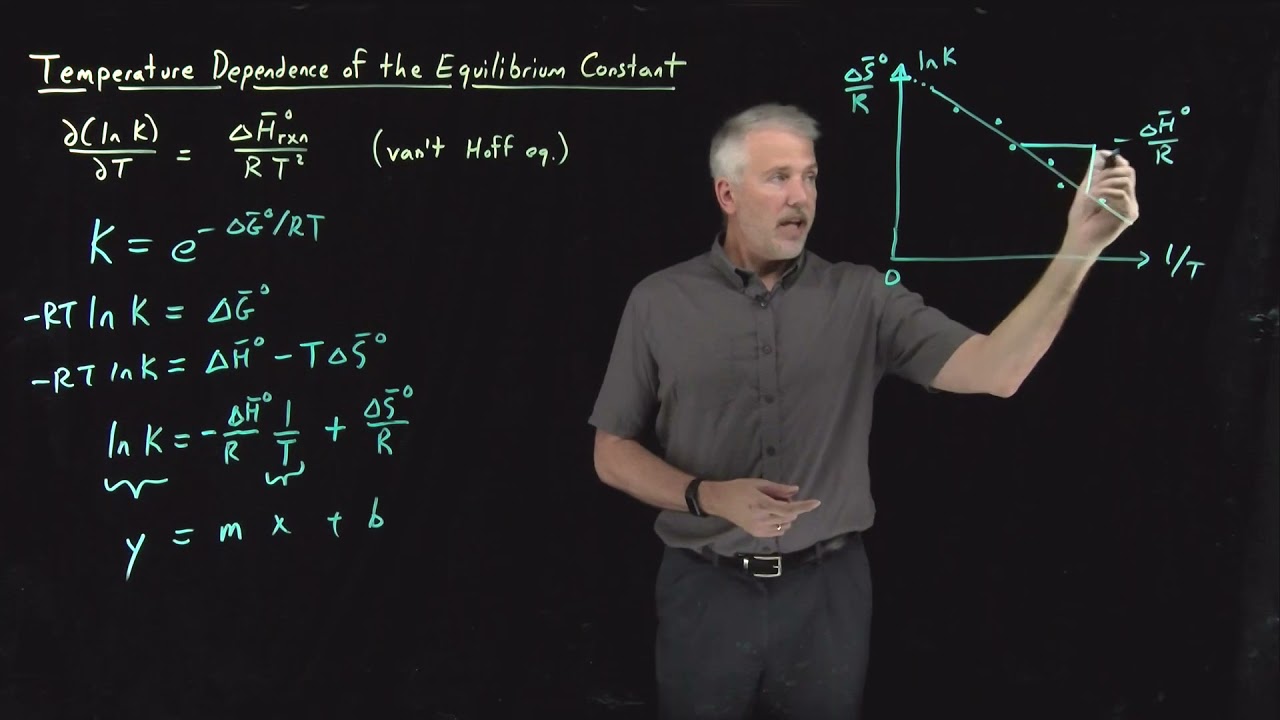
Using the standard relationship that the standard change in Gibbs energy for a reaction equals -RTlnK, where K is the equilibrium constant, the Gibbs-Helmholtz equation can be converted into the van't Hoff equation (van't Hoff isochore) to give a direct relationship of the derivative of lnK with respect to temperature to the enthalpy change of a reaction. Qualitatively, this equation can be used to predict the effect of the change of temperature on an equilibrium composition (and equilibrium yield) as is commonly predicted by Le Chatelier's Principle, as is often learnt about in high school Chemistry.
The final part of this video shows how you can use the van't Hoff equation in an experimental setting as it can relate to a gradient of straight line plots of specific data of equilibrium constants at different temperatures for a particular reaction. This data is often most easily obtained from electrochemical cell experiments. Plots of lnK versus 1/T, for example, will over modest temperature ranges give straight line graphs related to a specific reaction, from which the gradient can be used to calculate the enthalpy change for the reaction (delta H) and the "y-intercept" can be used to calculate the entropy change for the reaction (delta S).
Доступные форматы для скачивания:
Скачать видео mp4
-
Информация по загрузке: