miRNA and its Processing | Drosha Dicer Cleavage
Автор: Hussain Biology
Загружено: 2024-10-28
Просмотров: 4404
TMicroRNAs, or miRNAs, are small, non-coding RNA molecules consisting of about 20–24 nucleotides. Discovered in the early 1990s, miRNAs have become a critical area of research because they play a role in regulating gene expression by targeting specific messenger RNAs (mRNAs) for degradation or translational repression. miRNAs are central to processes such as cell growth, differentiation, apoptosis, and development. Their influence on cellular mechanisms means they are also linked to diseases, including cancer, cardiovascular conditions, and neurological disorders.
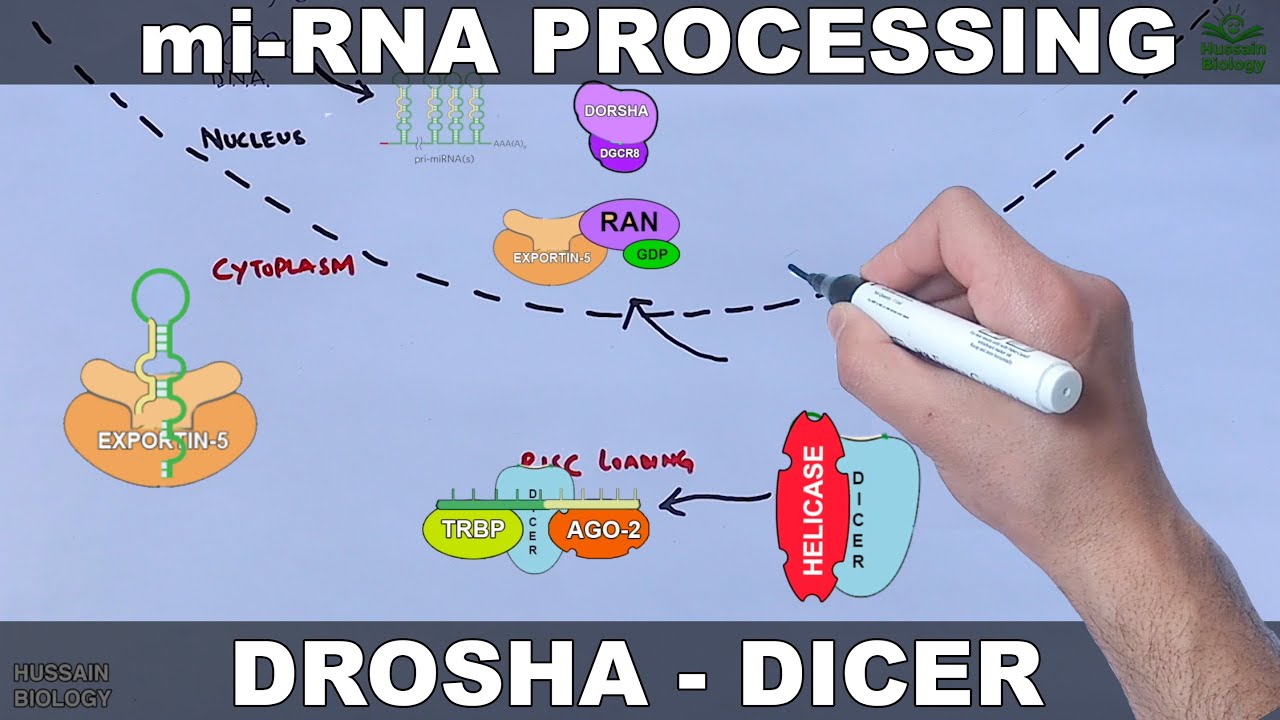
The biogenesis, or formation, of miRNAs is a multi-step process that takes place within the nucleus and cytoplasm:
a. Transcription of Primary miRNA (pri-miRNA)
The miRNA gene is transcribed by RNA polymerase II, creating a long primary miRNA transcript (pri-miRNA). This pri-miRNA has a hairpin loop structure that serves as the starting template for miRNA production.
b. Processing by Drosha and DGCR8
Inside the nucleus, the pri-miRNA is processed by a complex known as the microprocessor, consisting of the Drosha enzyme and its partner DGCR8 (DiGeorge Syndrome Critical Region 8). This complex cleaves the pri-miRNA to release a smaller, hairpin-structured molecule called precursor miRNA (pre-miRNA), which is about 60–70 nucleotides long.
c. Export to the Cytoplasm via Exportin-5
Once processed, pre-miRNA is transported out of the nucleus to the cytoplasm by Exportin-5, a nuclear transport receptor. This step is crucial, as it allows the precursor to undergo further processing, ultimately allowing the miRNA to exert its function.
d. Dicer Cleavage and Maturation
In the cytoplasm, the enzyme Dicer, a member of the RNase III family, processes the pre-miRNA further by cleaving the loop of the hairpin structure. This cleavage produces a mature miRNA duplex of about 20–24 nucleotides.
e. RISC Loading and Strand Selection
After Dicer processing, the mature miRNA duplex binds to the RNA-Induced Silencing Complex (RISC). One strand of the duplex, known as the guide strand, is retained and incorporated into the RISC, while the other strand (passenger strand) is discarded. The guide strand directs the RISC to specific target mRNAs, guiding gene silencing.
Доступные форматы для скачивания:
Скачать видео mp4
-
Информация по загрузке: