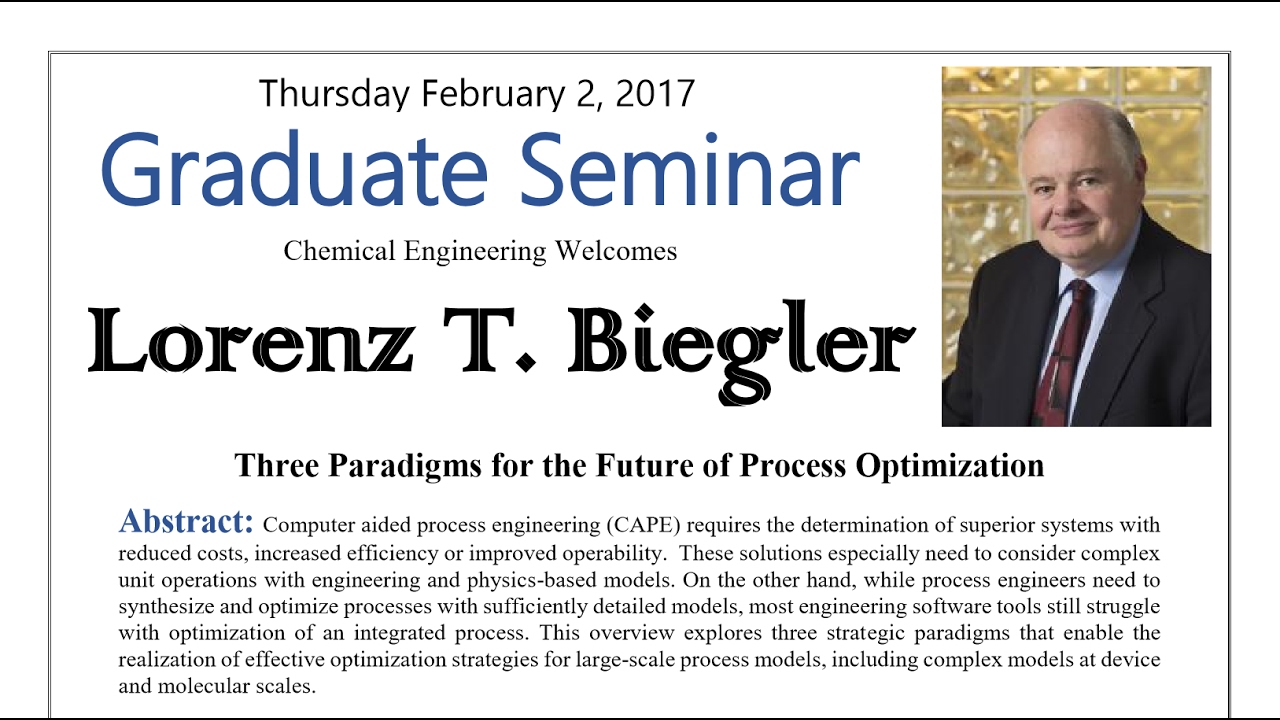
Larry Biegler: Three Paradigms for the Future of Process Optimization
Автор: APMonitor.com
Загружено: 2017-02-03
Просмотров: 3269
Computer aided process engineering (CAPE) requires the determination of superior systems with reduced costs, increased efficiency or improved operability. These solutions especially need to consider complex unit operations with engineering and physics-based models. On
the other hand, while process engineers need to synthesize and optimize processes with sufficiently detailed models, most engineering software tools still struggle with optimization of an integrated process. This overview explores three strategic paradigms that enable the realization of effective optimization strategies for large-scale process models, including complex models at device and molecular scales.
The first paradigm encompasses nonlinear programming (NLP) tools and their extensions to stability, NLP sensitivity and Mathematical Programs with Complementarity Constraints (MPCCs). Enabled by advanced optimization algorithms and solvers, they have become part of optimization modeling environments and rely on exact first and second derivatives. The second deals with improved formulations and solution strategies for large-scale, structured equation-oriented (EO) models that lead to well-posed MPCCs. In particular, we describe process optimization formulations that exploit characteristics of these solvers. These formulations are applied to process models that incorporate non-smooth functions and and a variety of bilevel
optimization problems, including phase and chemical equilibrium. Third, we describe the interaction and synergies of multi-scale process models through reduced models (RMs). While
RMs are widely applied in CAPE, their application to process optimization needs to be considered carefully, as loss of model accuracy may compromise the optimum solution. This problem is overcome through trust region based algorithms that incorporate ROMs and lead to provable convergence to the optimum of the original detailed optimization model, while preserving all of the features of EO optimization models.
These three paradigms will be demonstrated through a number of examples related to chemical and energy process applications, and future directions of these areas will be discussed.
Biographical Sketch of Lorenz T. Biegler
Lorenz T. (Larry) Biegler is currently the Head and Bayer University Professor of Chemical Engineering at Carnegie Mellon University. His research interests lie in computer aided process engineering (CAPE) and include flowsheet optimization, optimization of systems of differential and algebraic equations, process synthesis and algorithms for constrained, nonlinear process control. Contributions in these areas include analysis and development of nonlinear programming algorithms, optimization software design and application to real-world chemical processes and energy systems. He is an author on over 400 archival publications and 2 textbooks, has edited nine technical books and given numerous invited presentations at national and international conferences. His awards include the Lewis Award, Walker Award and Computers in Chemical Engineering Award, all given by AIChE, Curtis McGraw Research Award and CACHE Computing Award, given by ASEE, the INFORMS Computing Prize, and an honorary doctorate in engineering sciences from the Technical University of Berlin. He is a Fellow of AIChE and SIAM, and a member of the National Academy of Engineering.
Доступные форматы для скачивания:
Скачать видео mp4
-
Информация по загрузке: