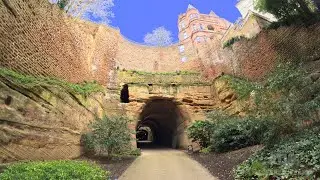
The Old Mapperley Tunnel Nottingham from Gedling Colliery
Автор: Steven T Spoon
Загружено: 2023-05-06
Просмотров: 4706
The Mapperley Tunnel is a historic railway tunnel located in the city of Nottingham, England. The tunnel was built in the mid-19th century as part of the Great Northern Railway, and was opened in 1876. It was constructed to provide a direct rail link between Nottingham and the market town of Mansfield.
The tunnel is approximately 930 yards long, and is situated between two stations, Sherwood and Daybrook. It was built through a hill and required the removal of large quantities of rock and soil. The tunnel was constructed using the cut-and-cover method, with the excavated material used to create embankments on either side of the tunnel.
The construction of the Mapperley Tunnel was a significant engineering feat at the time, and the use of steam-powered equipment helped to speed up the process. However, the project was not without its challenges. The unstable ground conditions in the area meant that the tunnel had to be lined with brick and iron to prevent collapses.
Despite these challenges, the Mapperley Tunnel was completed on time and within budget. It remained an important transport link for many years, serving both passengers and freight. However, with the decline of the coal industry in the area, the tunnel became less important and eventually fell into disuse.
The tunnel was built to allow trains to pass through the steeply sloping land of Mapperley Hills without having to negotiate a series of switchbacks. It was originally constructed as a single-track tunnel, but was later widened to accommodate two tracks.
The tunnel's construction was a challenging feat of engineering, as it had to be dug through solid sandstone. It was also one of the first railway tunnels to be built with a gradient of 1 in 100, which meant that trains could travel at higher speeds.
During its heyday, the Mapperley tunnel was a busy thoroughfare for trains transporting goods and passengers. However, with the decline of the railway industry in the mid-20th century, the tunnel fell into disuse and was eventually closed in 1960.
Today, the tunnel remains largely intact and is a popular destination for urban explorers and history enthusiasts. Although it is not open to the public, visitors can still catch a glimpse of the tunnel's entrance from the nearby footpath, which offers stunning views of the surrounding countryside. The tunnel is also a listed building, which means that it is protected by law as an important part of the country's heritage.
Доступные форматы для скачивания:
Скачать видео mp4
-
Информация по загрузке: