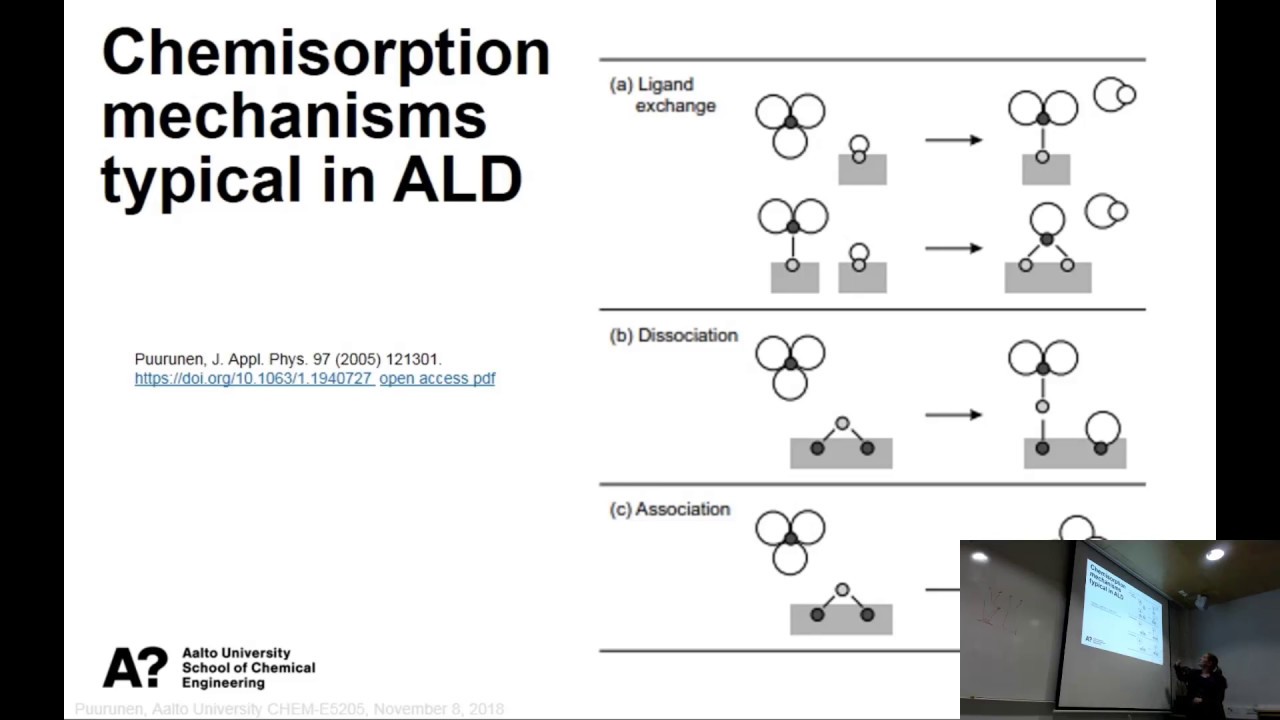
Record of invited "ALD 101" tutorial by Puurunen at ALD 2021 27.6.2021
Автор: Riikka Puurunen
Загружено: 2021-06-30
Просмотров: 2444
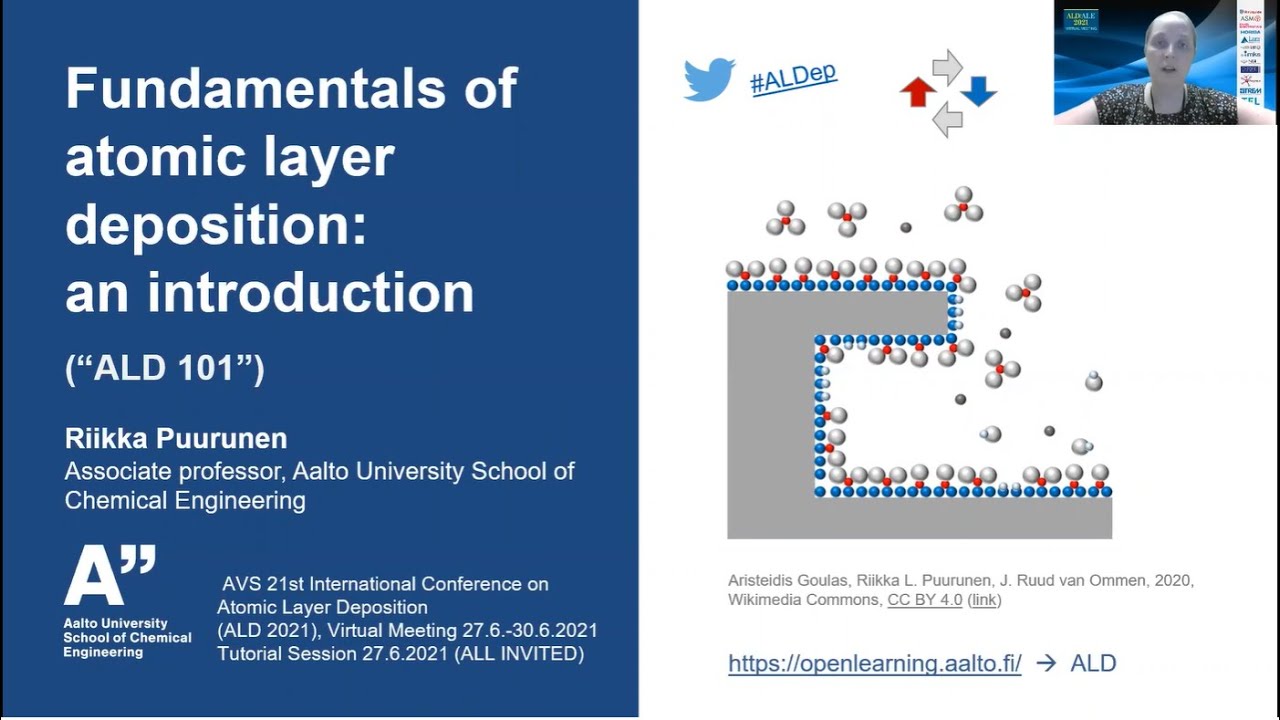
(INVITED) Fundamentals of atomic layer deposition: an introduction (“ALD 101”)
Riikka L. Puurunen, Aalto University School of Chemical Engineering, Department of Chemical and Metallurgical Engineering, at AVS 21st International Conference on Atomic Layer Deposition (ALD 2021), Virtual Meeting 27.6.-30.6.2021. Tutorial Session 27.6.2021
ABSTRACT:
Atomic layer deposition (ALD) has become of global importance as a processing technology for example in semiconductor device fabrication, and its application areas are continuously expanding. The significance of ALD was highlighted e.g. by the recent (2018) Millennium Technology Prize. Tens of companies are offering ALD tools, and thousands of people are involved in ALD R&D globally. A continuous need exists to educate new people on the fundamentals of ALD.
While ALD for manufacturing may be regarded mature, as a scientific field, ALD—in the author’s view—is developing. For example, understanding of the early history of ALD is evolving, related to the two independent inventions of ALD under the names Atomic Layer Epitaxy in the 1970s and Molecular Layering in the 1960s [1-4]. Also, significantly varying views exist in the field related to the description and meaningfulness of even some core ALD concepts [5].
The purpose of this invited “ALD 101” tutorial is to familiarize a newcomer with fundamentals of ALD. The presentation largely follows the organization of a recent encyclopedia chapter on ALD [6]. Surface chemistry concepts will be introduced, such as ideal ALD from repeated, separate self-terminating (saturating and irreversible) reactions; growth per cycle in ALD; various monolayer concepts relevant to ALD; typical classes of surface reaction mechanisms and saturation-determining factors; growth modes; and ways to describe growth kinetics. Concepts, where differing views exist in the field and which thus need special attention, are pointed out. Typical deviations from the presented ideality are discussed.
For continuous education, a collaborative OpenLearning website on ALD is under construction [7]. Many of the images used in this tutorial—and in Refs. 6 and 7—are available in Wikimedia Commons [8] for easy and free reuse. To contribute to collective learning of the early history of ALD, the open-science effort Virtual Project on the History of ALD [4] still welcomes new volunteer participants. '
[1] E. Ahvenniemi et al., J. Vac. Sci. Technol. A 35 (2017) 010801 (2017).
[2] R.L. Puurunen, ECS Transactions 86 (6) (2018) 3-17; OA: DOI:10.1149/osf.io/exyv3
[3] G.N. Parsons et al., J. Vac. Sci. Technol. A 38 (2020) 037001.
[4] http://vph-ald.com
[5] J.R. van Ommen, R.L. Puurunen, ALD 2020, • "On the fundamentals of ALD: the importanc...
[6] J.R. van Ommen, A. Goulas, R.L. Puurunen, Kirk-Othmer Encyclopedia on Chemical Technology, submitted.
[7] http://openlearning.aalto.fi, ALD
[8] https://commons.wikimedia.org/wiki/Ca...
Доступные форматы для скачивания:
Скачать видео mp4
-
Информация по загрузке: