#semiconductors
Автор: IITian Neeraj Kushwaha
Загружено: 2026-01-15
Просмотров: 3
#semiconductors #class12 #intrinsic semiconductor #extrinsic semiconductor
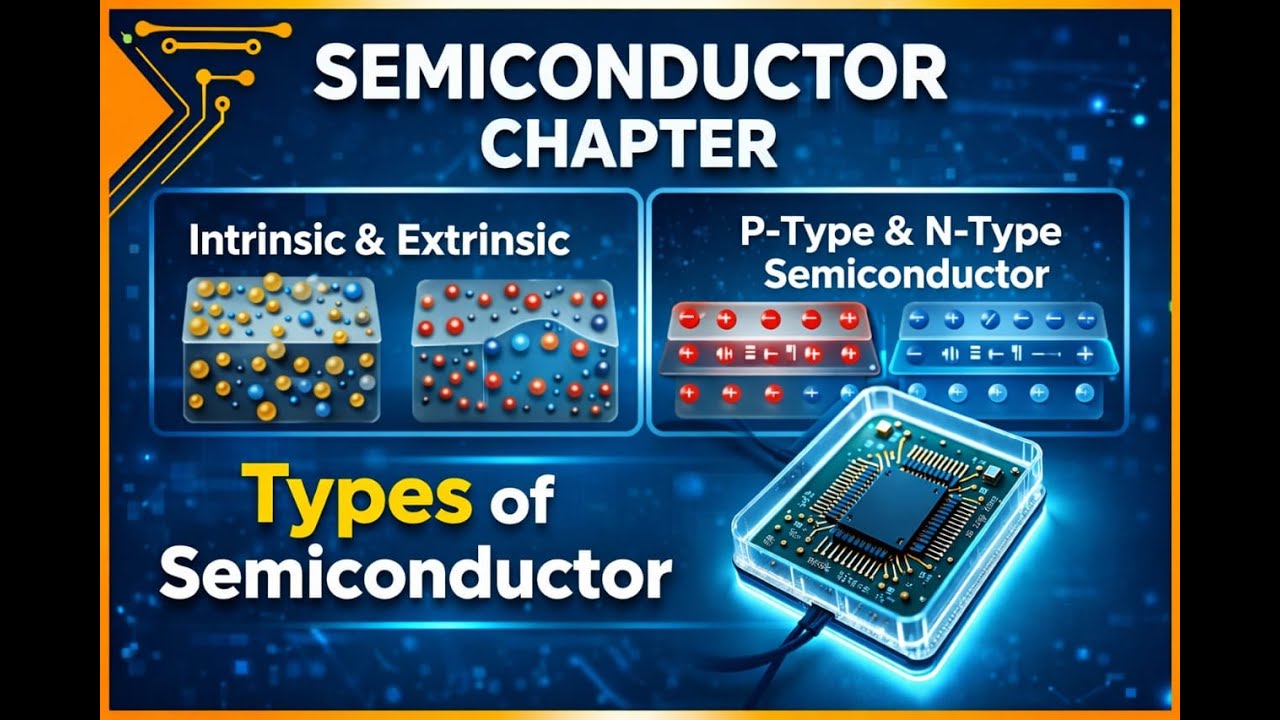
What is a Semiconductor?
A semiconductor is a material whose electrical conductivity lies between conductors and insulators. Its conductivity increases with temperature and can be controlled by adding impurities.
👉 Common examples: Silicon (Si) and Germanium (Ge)
1. Intrinsic Semiconductor
Definition
An intrinsic semiconductor is a pure semiconductor with no intentional impurities added.
Charge Carriers
Electrons (in conduction band)
Holes (in valence band)
Number of electrons = number of holes
Key Features
Very low conductivity at room temperature
Conductivity increases when temperature increases
Conduction occurs due to thermally generated electron–hole pairs
Energy Band Explanation
Small energy gap (~1 eV)
At higher temperature, electrons jump from valence band → conduction band
Leaves behind holes
Examples
Pure Silicon
Pure Germanium
📌 Important point:
In intrinsic semiconductors, electrons and holes are equally responsible for conduction.
2. Extrinsic Semiconductor
Definition
An extrinsic semiconductor is formed by adding a small amount of impurity to a pure semiconductor to increase its conductivity.
This process is called doping.
Types of Extrinsic Semiconductors
n-type semiconductor
p-type semiconductor
3. n-Type Semiconductor
Doping
Doped with pentavalent (Group V) impurities
Examples: Phosphorus (P), Arsenic (As), Antimony (Sb)
How It Works
Pentavalent atoms have 5 valence electrons
4 electrons form covalent bonds with silicon
1 extra electron becomes free
Charge Carriers
Majority carriers: Electrons
Minority carriers: Holes
Energy Band Diagram
Donor energy level lies just below the conduction band
Very little energy is required to free electrons
Key Characteristics
High conductivity due to free electrons
Electrical conduction mainly by electrons
Electrically neutral overall
📌 Memory tip:
n-type → negative charge carriers (electrons)
4. p-Type Semiconductor
Doping
Doped with trivalent (Group III) impurities
Examples: Boron (B), Aluminium (Al), Gallium (Ga)
How It Works
Trivalent atoms have 3 valence electrons
One bond remains incomplete → hole is created
Charge Carriers
Majority carriers: Holes
Minority carriers: Electrons
Energy Band Diagram
Acceptor energy level lies just above the valence band
Electrons easily move from valence band to fill holes
Key Characteristics
High conductivity due to holes
Electrical conduction mainly by holes
Electrically neutral overall
📌 Memory tip:
p-type → positive charge carriers (holes)
Comparison Table
PropertyIntrinsicn-Typep-TypePurityPureImpureImpureDopingNoPentavalentTrivalentMajority carriersElectrons & HolesElectronsHolesConductivityLowHighHighFermi levelMiddle of band gapNear conduction bandNear valence band
Conclusion
Intrinsic semiconductors are pure and have limited conductivity
Extrinsic semiconductors are doped to enhance conductivity
n-type: electrons dominate conduction
p-type: holes dominate conduction
These concepts form the foundation of diodes, transistors, ICs, and all modern electronics ⚡
Доступные форматы для скачивания:
Скачать видео mp4
-
Информация по загрузке: