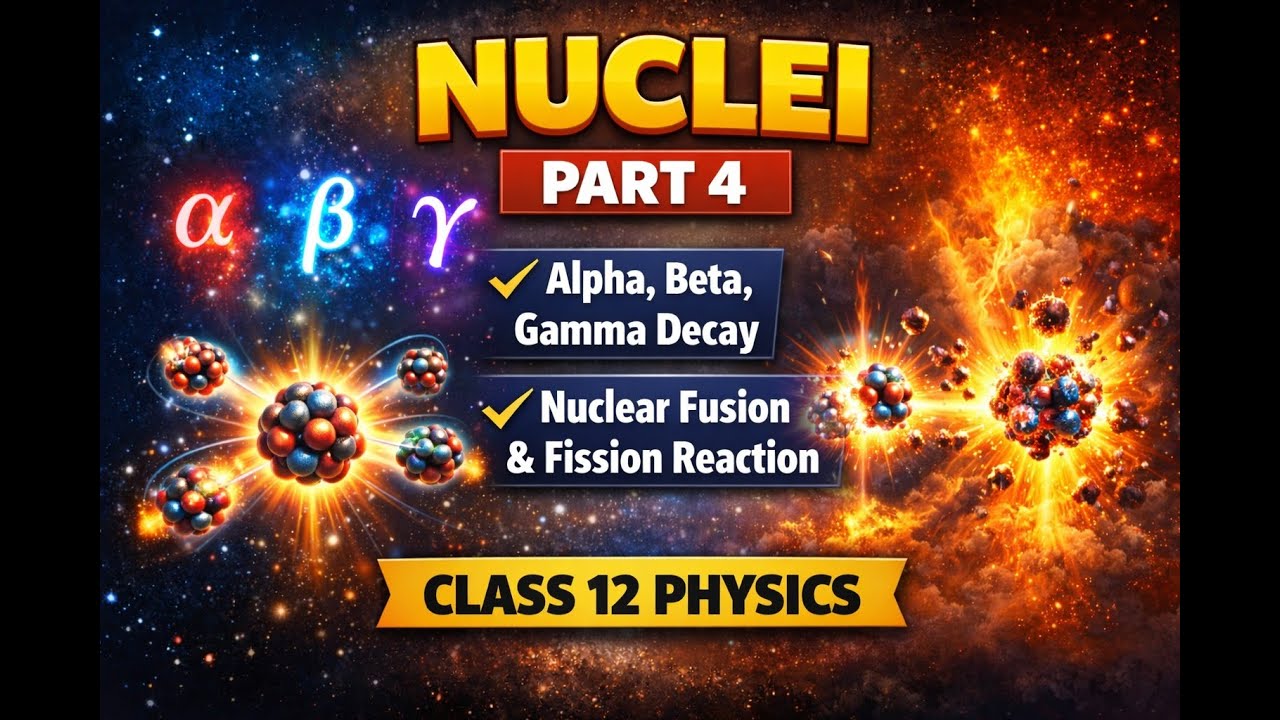
Nuclei Part 4 | Radioactivity Decay | Nuclear Fission | Nuclear Fussion
Автор: IITian Neeraj Kushwaha
Загружено: 2026-01-11
Просмотров: 0
| Radioactivity Decay | Nuclear Fission | Nuclear Fussion
Radioactivity of Nuclei – Chapter Description
Radioactivity is a fundamental nuclear phenomenon in which unstable atomic nuclei spontaneously emit radiation to attain a more stable configuration. This process is natural, random, and independent of external conditions such as temperature, pressure, or chemical state.
Discovery of Radioactivity
Radioactivity was discovered by Henri Becquerel (1896) while studying uranium salts. Later, Marie and Pierre Curie made significant contributions by discovering new radioactive elements like polonium and radium.
Types of Radioactive Emissions
Radioactive nuclei emit three main types of radiations:
Alpha (α) rays
These are helium nuclei (⁴₂He) with high mass and charge. They have low penetrating power but high ionizing power.
Beta (β) rays
These are fast-moving electrons or positrons emitted during nuclear transformation. They have moderate penetrating and ionizing power.
Gamma (γ) rays
These are high-energy electromagnetic waves with very high penetrating power and low ionizing power.
Доступные форматы для скачивания:
Скачать видео mp4
-
Информация по загрузке: