How the Mughal Empire Built a Secret Spy Network
Автор: Heritage Chronicles
Загружено: 2025-11-08
Просмотров: 215166
What if the true power of the Mughal Empire did not lie in its cannons or armies —
but in information?
This video uncovers the Secret Intelligence System of the Mughals, a vast spy network that stretched from Lahore Fort to Agra Fort, from Fatehpur Sikri to Delhi Red Fort, and across Bengal, Gujarat, and the Deccan Plateau.
For over three centuries, the Mughal throne was held together not by force — but by news.
🕵️ Inside the Empire of Secrets
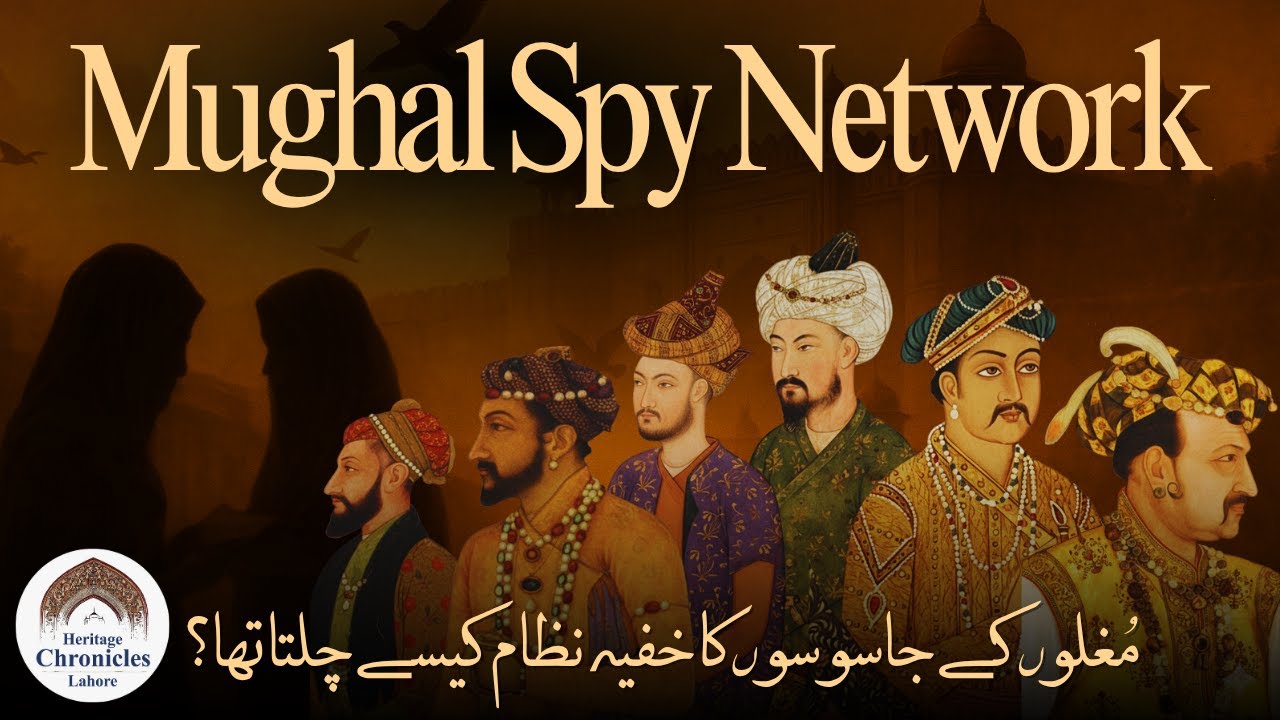
Zahir-ud-Din Muhammad Babur (1526 – 1530 CE) – the founder of the Mughal dynasty, who used disguised merchants and Sufi travelers as informants from Kabul to Delhi.
Nasir-ud-Din Muhammad Humayun (1530 – 1540, 1555 – 1556) – continued the same methods, relying on loyal couriers who memorized entire letters to avoid discovery.
Jalal-ud-Din Muhammad Akbar (1556 – 1605) – transformed espionage into an institution by creating the post of Waqia-Navis (royal news writers).
From Lahore, Multan, Kashmir, Bengal, and Gujarat, these officials sent weekly “Akhbar” reports straight to the emperor in Fatehpur Sikri.
Their writings described markets, soldiers, governors, even social tensions — forming the empire’s first daily intelligence bulletin.
Nur-ud-Din Muhammad Jahangir (1605 – 1627) – built a network of palace spies under Empress Nur Jahan, using maids, eunuchs, and cooks to monitor royal intrigues.
Shahab-ud-Din Muhammad Shah Jahan (1628 – 1658) – expanded the Dak-Chowki Postal Network, appointing the Darogha-e-Dak Chowki to manage horse couriers and coded reports moving between Delhi, Lahore, Kabul, and Burhanpur.
Muhi-ud-Din Muhammad Aurangzeb Alamgir (1658 – 1707) – refined the system into a disciplined state intelligence bureau, sending agents even to Isfahan, the court of Shah Abbas II of Persia.
Each evening, the emperor received the Akhbar-e-Darbar-e-Muʿalla —
the “Newspaper of the Court” compiled from hundreds of field reports.
Every courier, spy, and code writer formed part of a living machine that kept an empire under watch.
🕊️ How the Network Worked
Harkaras (foot couriers) relayed bamboo-sealed letters day and night along the Grand Trunk Road, first built by Sher Shah Suri and perfected by Akbar.
The legendary Meora couriers of Mewat ran hundreds of miles without stopping, sometimes using opium to endure fatigue.
Carrier pigeons trained in Agra, Burhanpur, and Lahore delivered silk-written messages — white for peace, red for royal command, blue for imperial movement — exactly as recorded in Tuzuk-i-Jahangiri.
Ramz-Navis (cipher writers) hid military orders in Persian couplets.
Example: “The spring breeze enters the garden, and the nightingale moves its nest” secretly meant “Transfer the northern regiment.”
🏰 Architecture and Espionage
Even Mughal architecture served intelligence:
the domes of Agra Fort, Red Fort Delhi, and Lahore Fort were engineered for sound reflection,
so whispers carried directly to the emperor’s seat.
Marble jali screens allowed unseen observation — early surveillance windows.
In Shalimar Gardens Lahore, cascading water masked conversations,
creating one of the world’s first acoustic privacy systems.
⚔️ The Fall of the Network
After Aurangzeb Alamgir’s death in 1707, the network began to decay.
Governors bribed spies, reports slowed, and corruption spread.
When Nadir Shah of Persia invaded Delhi in 1739,
Emperor Muhammad Shah Rangeela only learned of it when cannons thundered at the Red Fort.
By the time of Bahadur Shah Zafar (1857), the last Mughal emperor,
the same postal-intelligence system had been absorbed by the British East India Company,
and the emperor received news of the Delhi uprising from the British Resident, not his own men.
#MughalSpyNetwork #MughalEmpireHistory #MughalIntelligenceSystem #AkbarTheGreat #AurangzebAlamgir #JahangirShahJahan #LahoreFort #IndianHistoryDocumentary #HeritageChronicles #ShahabOmer
Доступные форматы для скачивания:
Скачать видео mp4
-
Информация по загрузке: