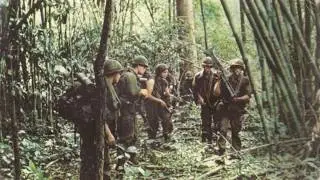
Why This American Hero Chose Death Against 400 Japanese Soldiers
Автор: Unseen Comrades
Загружено: 2026-01-06
Просмотров: 97
October 25, 1942, Guadalcanal. Platoon Sergeant Mitchell Paige, 24 years old, from Charleroi, Pennsylvania, crouched behind his Browning M1917A1 machine gun as darkness fell over Henderson Field. The 7th Marines held a seven-hundred-yard defensive line against the jungle—the weakest point in the entire American perimeter. Behind him, just 1,500 yards away, sat the only airfield keeping the United States in the Pacific War. If Henderson Field fell, Guadalcanal fell. If Guadalcanal fell, Japan's drive toward Australia continued unopposed.
Intelligence had warned them: The Japanese Sendai Division—3,000 veteran jungle fighters—were massing for a final assault to retake the airfield. Paige commanded four water-cooled machine guns and thirty-three Marines holding a position the enemy would hit with overwhelming force. At 2130 hours, the Japanese attacked.
Within thirty minutes, Paige's world collapsed. Japanese mortars and artillery shredded his positions. Corporal Leipart—shot through the head. Private Totman—killed in the first wave. Private McNabb—legs shattered by shrapnel. One by one, his Marines fell until Paige stood alone with four machine guns and hundreds of Japanese soldiers charging through the darkness.
The smart move was to retreat. Fall back to secondary positions. Save himself. No one would blame a sergeant whose entire platoon had been killed or wounded. But Mitchell Paige understood what retreat meant: Japanese artillery would reach Henderson Field by dawn. American aircraft would be destroyed on the ground. The entire Guadalcanal campaign—three months of brutal fighting, thousands of Marines dead from combat and disease—would be for nothing.
So he made a choice that would define Marine Corps history: He stayed. Alone.
For the next eight hours, Platoon Sergeant Mitchell Paige operated four machine guns by himself. He would fire one Browning until the barrel glowed red and the water jacket boiled dry, then sprint thirty yards through Japanese fire to the next gun position, firing controlled bursts to make the enemy believe his entire section was still operational. Back and forth, gun to gun, all night long—a one-man defensive line against an entire Japanese regiment.
The physical reality was impossible. Each Browning M1917A1 weighed 41 pounds, required constant feeding of 250-round ammunition belts, and needed water refills as the barrels superheated. Paige's hands burned from gripping metal that reached 800 degrees. His shoulders screamed from absorbing recoil never meant for one man. But he kept firing.
But Paige wasn't finished. When the Japanese counterattacked at first light, he grabbed his rifle, rallied the arriving Marines, fixed bayonets, and led a charge that drove the enemy back into the jungle. The man who had defended alone for eight hours now attacked, his courage so absolute it infected every Marine who witnessed it.
On May 21, 1943, in Melbourne, Australia, General Alexander Vandegrift placed the Medal of Honor around Mitchell Paige's neck. The citation stated he had shown "extraordinary heroism and conspicuous gallantry in action above and beyond the call of duty." But even those words couldn't capture the impossible reality of what happened on that ridge.
Then something extraordinary occurred: Mitchell Paige's story began fading from public memory while becoming foundational to how the Marine Corps trains every leader. He returned to civilian life, raised a family, and died quietly in 2003 at age 84. Most Americans born after 1960 never heard his name.
But inside the Marine Corps, his story never faded. Today, Mitchell Paige's action at Guadalcanal is taught at:
Marine Corps University, Quantico (Warfighting Course case study)
Basic School officer training ("Paige's Ridge" leadership scenario)
Machine Gunners Course, Camp Lejeune (required instruction)
Infantry Officers Course (defensive operations template)
The Marine Corps Leadership Reaction Course includes "Paige's Ridge"—a scenario where officer candidates must defend a position against simulated overwhelming attack with limited resources. Every Marine machine gunner learns his name within their first week at their unit, usually from a gunnery sergeant who learned it from another in an unbroken chain extending back to 1942.
In 1999, the Navy christened USNS Mitchell Paige (T-AKR-304), a vehicle cargo ship that still serves today. The vessel maintains a permanent display documenting his October 1942 action—ensuring every sailor aboard knows the name of the Marine who held impossible ground.
This is the complete story of the American sergeant who operated four machine guns alone for eight hours, disappeared into obscurity, and became the foundation for how the Marine Corps teaches courage under fire.
Unseen Comrades brings you Medal of Honor recipient stories. Subscribe for forgotten American heroes who changed military history.

Доступные форматы для скачивания:
Скачать видео mp4
-
Информация по загрузке: