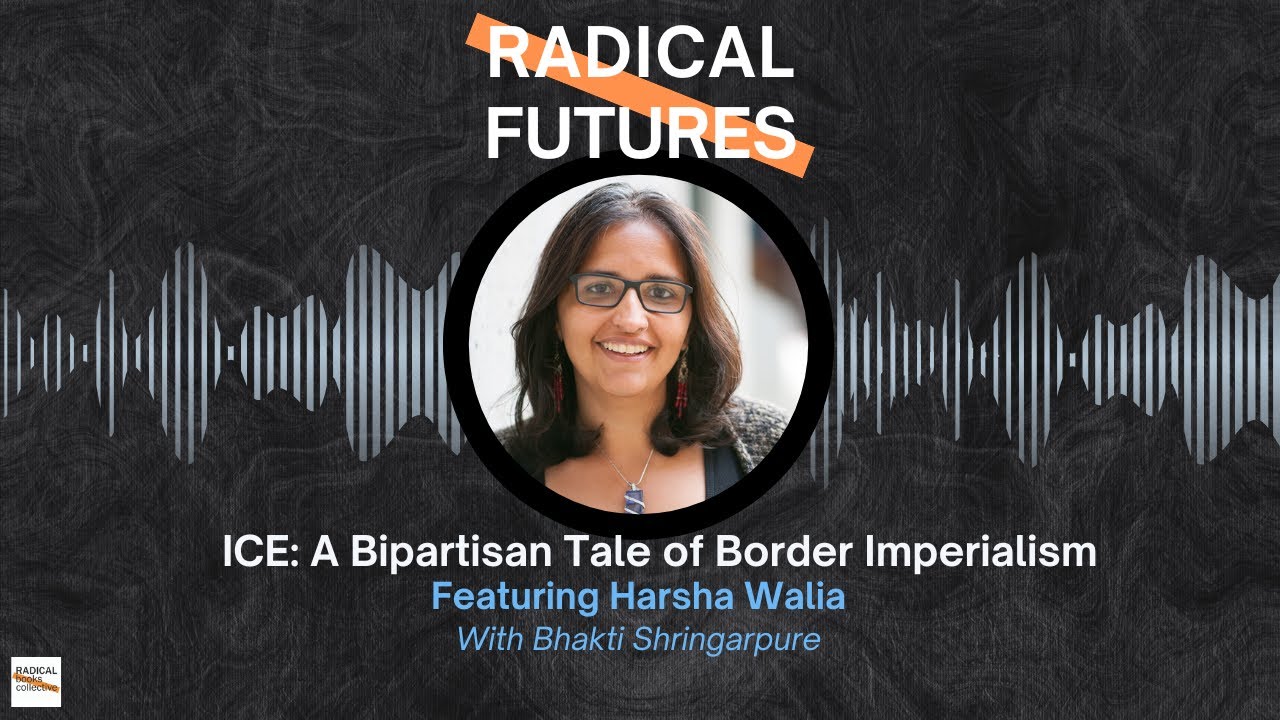
Episode 22: ICE, A Bipartisan Tale of Border Imperialism | Radical Futures podcast
Автор: Radical Books Collective | WARSCAPES
Загружено: 2026-01-21
Просмотров: 111
Featuring Harsha Walia
“Border regimes are some of the most normalized forms of violence,” writer and activist Harsha Walia says, because even the most progressive people “really struggle with the idea of abolishing the border.”
Recently, the murder of Renee Good in the bright light of day, in Minneapolis, has sparked outrage across the US. However, this is a culmination of the past several months of an escalation in the war on migrants and in policing practices. The stories of Mahmoud Khalil, Rümeysa Öztürk and Kilmar Ábrego García were early signs that an escalation in abductions and brutalization was coming. ICE now appears to be wielding spectacular levels of power and unleashing daily violence on a new scale. Walia, who has followed and written about borders and migrations for several years, is horrified at what she is seeing but not entirely surprised by this escalation.
Walia wants to broaden the scope of this conversation. Today ICE “is one of the largest law enforcement agencies in the United States. In fact, its budget outpaces many militaries of the world.” But even before there was ICE, the core function of any border regime is to “enforce borders, to enact deportation and detention, and to escalate border enforcement in different places.” This escalation can occur at the border itself as with US border with Mexico or as a maritime build-up with the Caribbean or “inland” which means within neighborhoods and within the so-called territory of the US.
“Even though at different times, the spectacle and horror is different, the ideology and premise is the same, which is to terrorize migrant communities and to enact detention and deportation...It is not to always deport people, but it's to make them more vulnerable to employers and to the social context in which migrants live.”
In offering a brief history of ICE, Walia stresses the bipartisan nature of the agency. It was created by George W. Bush in 2003 in the aftermath of 9/11. “An immensely violent and large agency,” ICE comes out in a moment “when the war on terror was increasingly merged with the war on migrants.” But she argues that it is the Clinton administration that “laid the ground for border militarization as we know today. And that was by putting in millions of dollars to securitize the border, all of these different operations in California and Arizona and Texas to basically make it so that crossing the border became a matter of life and death for people.”
The Obama and Biden administrations have followed suit and have been instrumental in harnessing brutal bordering practices, a key element of which has been the externalization of the border. They have poured billions of dollars on “border enforcement into other countries, which is why now Mexico has a much larger detention and deportation system than the United States, because the US has outsourced its violence to countries in South and Central America.”
None of this takes away from the fact that Trump has taken it to new levels by putting thousands of ICE patrols on the streets, by pausing US visa applications from 75 countries, and by giving leeway for hate speech and racism against migrants. Walia warns against exceptionalizing Trump’s villainy because “Trump did not create this entire administration or structure. All of the infrastructure that goes into border enforcement predates him.”
Additionally, Trump is part of a global trend “whether it is the escalation of Zionism and Zionist and genocidal violence, the escalation in India and of Brahminical Hindutva forces, and we can look at other parts of Europe where this is happening.”
Walia rightly points out that even if the American empire collapses today, countries like India and UAE will push the same horrible agendas. Thus regardless of American hegemony, “there is no denying that transnational accumulation, capitalist accumulation and empire-making is no longer the domain of the imperial core. Even if these are sub-imperialisms, they're advancing at a rate that is unfathomable and causing violence on people's lives and misery for people in ways that are unfathomable.”
Unfortunately, this is just the tip of the iceberg because “there are over 17,000 agencies that have jurisdiction over migrants in the United States.” Any of these could be empowered if ICE is gone. “So it's about understanding that it's not about abolishing ICE. It's about abolishing the system and the power that ICE upholds.”
Further reading:
Border and Rule: Global Migration, Capitalism, and the Rise of Racist Nationalism by Harsha Walia https://www.haymarketbooks.org/books/...
Hosted by Bhakti Shringarpure.
Edited by Agatha Jamari
Radical Futures is produced by Warscapes
Title Music: “Cottonstorm” by Bayern Boom Beat
Subscribe | Follow www.radicalbookscollective.com
Доступные форматы для скачивания:
Скачать видео mp4
-
Информация по загрузке:








![MN ICE lawsuit: AG Ellison updates after hearing [FULL]](https://imager.clipsaver.ru/cHpJ98MZ7sA/max.jpg)