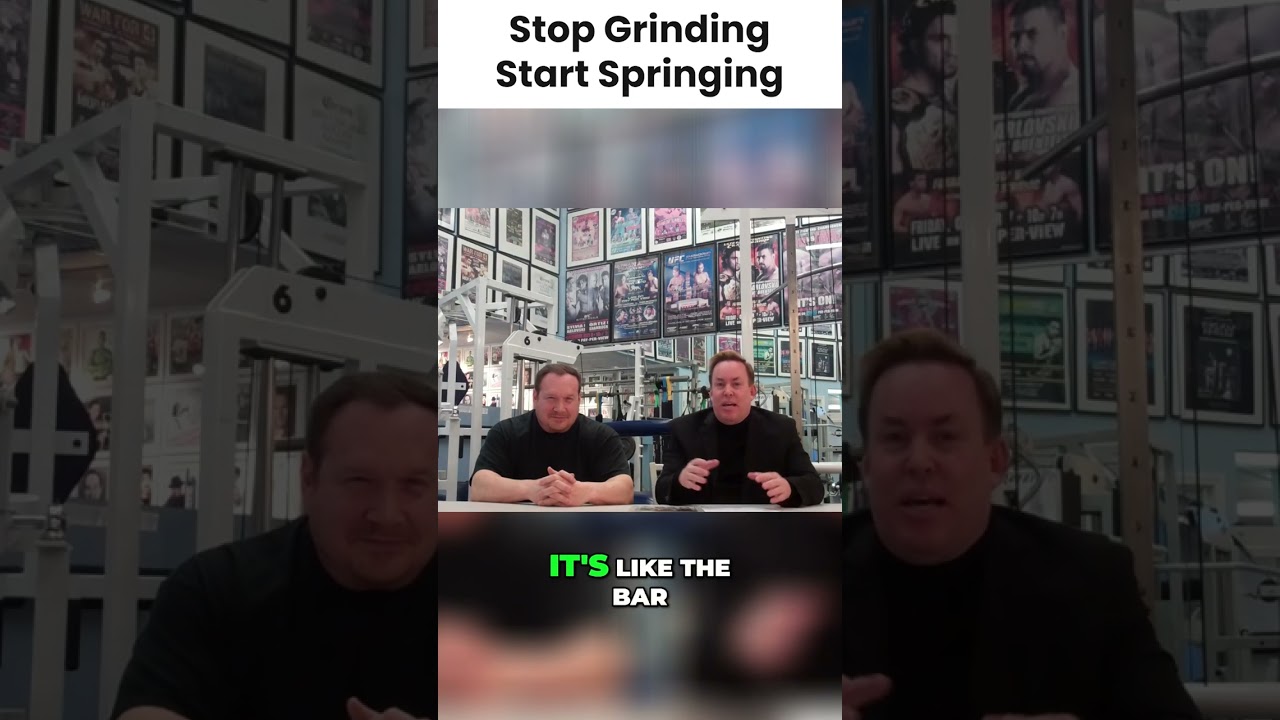
The Training Mistakes That Slowly Kill Your Elasticity and Spring
Автор: Team Doctors Academy
Загружено: 2026-01-15
Просмотров: 7
Most people grow up believing the human body works like a machine. You pull levers. You push joints. You load weight. You grind repetitions. This idea feels logical, and it dominates modern gym culture. But in my clinical experience, this way of thinking explains why so many strong people still feel stiff, sore, heavy, and worn down.
Your body is not a machine. It is a living spring system.
When a spring is treated like a rigid structure, it doesn’t adapt—it eventually fails. The same thing happens in the human body when elastic movement is replaced by constant bracing, grinding, and compression.
In strength sports like powerlifting, athletes chase bigger numbers in the squat bench deadlift using progressive overload, max effort training, and structured periodization. None of that is inherently wrong. But when elastic rebound disappears, strength turns into compression tolerance. The body becomes strong but fragile.
Contrast that with Olympic lifting. In the snatch and clean and jerk, you cannot grind. You must rebound. Success depends on triple extension, timing and coordination, bar speed, and efficient turnover. Olympic lifters move like springs because springs are the only way the physics works.
The same principle governs plyometrics, where the stretch-shortening cycle allows elastic energy storage and release. Every jump, landing, and change of direction depends on rebound. When the amortization phase slows down, stress increases and performance drops.
This is not about injury. It is about fatigue, tension, and lost elasticity.
Muscles tighten to protect when motion is uneven, when load is not shared, and when springs stop rebounding. Over time, people feel “old,” heavy, and restricted—not because they are weak, but because their spring system is exhausted.
This is where the Human Spring Approach is different.
Dr. James Stoxen does not ask how strong a muscle is. He asks how well the system rebounds. He looks at neuromuscular efficiency, dynamic stability, coordination, and ease of movement. Strength that lasts is elastic, not forced.
Daily life compresses the system through sitting, driving, screens, stress, and repetition. That is why daily reset matters. Tools like Vibeassage® Pro and Vibeassage® Sport are not treatments or cures. They are recovery and comfort tools used to help muscles relax, reduce guarding, support circulation, and make movement feel easier again.
Used alongside movement, walking, and varied activity, they support the conditions that allow springs to behave like springs again—without medical claims or promises.
Real strength is not a single lift. It is how well you move, how long you last, how well you recover, and how comfortable your body feels in daily life.
That is sustainable strength.
That is the Human Spring Approach.
Team Doctors Resources
✓ Check out the Team Doctors Recovery Tools
The Vibeassage Sport and the Vibeassage Pro featuring the TDX3 soft-as-the-hand Biomimetic Applicator Pad
https://www.teamdoctors.com/
✓ Get Dr. Stoxen’s #1 International Bestselling Books
Learn how to understand, examine, and reverse your TOS—without surgery.
https://drstoxen.com/1-international-...
✓ Check out Team Doctors Online Courses
Step-by-step video lessons, demonstrations, and self-treatment strategies.
https://teamdoctorsacademy.com/
✓ Schedule a Free Phone Consultation With Dr. Stoxen
Speak directly with him so he can review your case and guide you on your next steps.
https://drstoxen.com/appointment/
#HumanSpring #ElasticStrength #Powerlifting #OlympicWeightlifting
#Plyometrics #MovementQuality #StrengthTraining
#NeuromuscularEfficiency #DynamicStability #Recovery
#Vibeassage #TeamDoctors #SustainableStrength
#InjuryPrevention #AthleteEducation #MovementScience
Доступные форматы для скачивания:
Скачать видео mp4
-
Информация по загрузке: