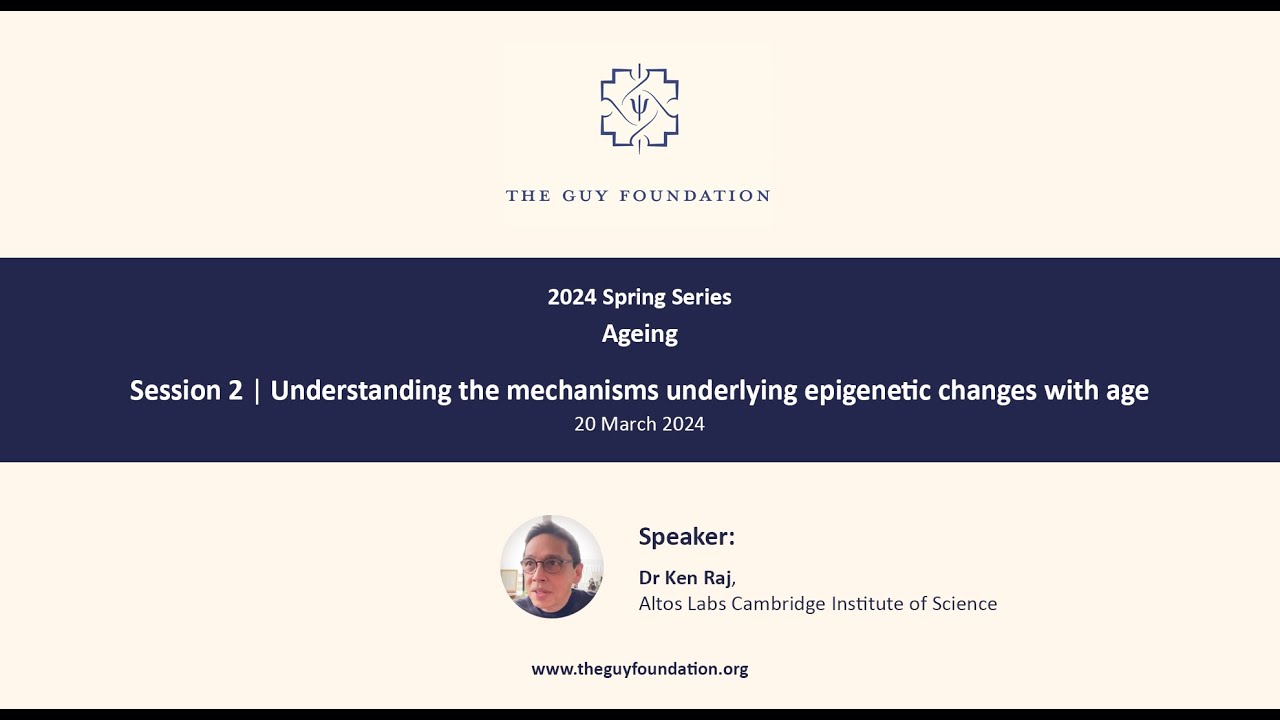
Ken Raj (2024) Understanding the mechanisms underlying epigenetic changes with age
Автор: The Guy Foundation
Загружено: 2024-03-26
Просмотров: 396
Understanding the mechanisms underlying epigenetic changes with age.
Dr Ken Raj, Altos Labs Cambridge Institute of Science.
The Guy Foundation 2024 Spring Series.
Start: 00:00
Professor Stanley Botchway: 01:21
Dr Ken Raj: 08:27
Abstract:
The cause of ageing is perhaps one of the oldest unanswered questions that continues to garner interest and hypotheses, of which the “wear-and-tear model” is the simplest, and most widely accepted. This intuitive notion, however, is called into question by recent development of epigenetic clocks, which are mathematical descriptions that can accurately predict the age of a person based on the degree of modifications (methylation) on specific positions on their DNA. The specificity of these age-related methylation changes in genome location and in time, in every healthy human being, cannot be readily explained by random wear-and-tear. Instead, it strongly advocates a non-random process. Epigenetic clocks have since been developed for many specific mammalian species, suggesting that the process that drives human ageing is similar to those that do so across all mammals. This proposition of the universality of the ageing process is very strongly supported by the Universal Mammalian clock, which is a single mathematical description that can accurately predict the age of all mammals regardless of species. Clues to the underlying process of ageing emerge from the features of the specific genomic locations that undergo methylation changes with age. These sites are located primarily in promoters that regulate expression of genes that participate in the process of embryonic development. They are called bivalent promoters as they are marked by two opposing modifications on histones, which are proteins around which DNA is wound. One modification stimulates expression and the other represses it. Importantly, methylation of these promoters causes the loss of bivalency. This leads to the loss of the cell’s ability to regulate the expression of developmental genes. Consequently, some genes are inappropriately expressed, others cannot be expressed when required. Collectively, in time, cells, tissues, and organs reduce their efficiency and function, resulting in the gradual ageing of the organism.
Visit our website: https://www.theguyfoundation.org
Read our newsletter: https://www.theguyfoundation.org/news/
Find out about other conferences and meetings: https://www.theguyfoundation.org/our-...
Keywords: mTOR protein function, aging, ageing, mTORC1, S6K1, 4EBP1, cancer research, cellular DNA damage response, epigenetic clocks, DNA, methylation, ageing, Horvath, epigenetic clock, accelerated ageing, chronological age, tissue-specific differentiation/specialisation Yamanaka, OSKM, iPS, Lopez Hallmarks of Ageing, deregulated nutrient sensing, Rapamycin, mLST8, FKBP12, intercellular communication, stem cell depletion, mitochondrial dysfunction, histone modifications, chromatin, bivalent chromatin domains, PRC2, embryonic development, regulation of expression, loss of bivalency, Hox genes
Доступные форматы для скачивания:
Скачать видео mp4
-
Информация по загрузке: