How to Effectively Organize Exchanges and Queues in RabbitMQ for Async CQRS Buses
Автор: vlogize
Загружено: 2025-07-28
Просмотров: 1
Discover the best practices for organizing exchanges and queues in RabbitMQ to optimize your Async CQRS setup, ensuring efficient and manageable architecture.
---
This video is based on the question https://stackoverflow.com/q/67478288/ asked by the user 'Isaac' ( https://stackoverflow.com/u/4541944/ ) and on the answer https://stackoverflow.com/a/67483792/ provided by the user 'Tore Nestenius' ( https://stackoverflow.com/u/68490/ ) at 'Stack Overflow' website. Thanks to these great users and Stackexchange community for their contributions.
Visit these links for original content and any more details, such as alternate solutions, latest updates/developments on topic, comments, revision history etc. For example, the original title of the Question was: How to organize exchanges and queues in rabbitmq to use with async CQRS buses
Also, Content (except music) licensed under CC BY-SA https://meta.stackexchange.com/help/l...
The original Question post is licensed under the 'CC BY-SA 4.0' ( https://creativecommons.org/licenses/... ) license, and the original Answer post is licensed under the 'CC BY-SA 4.0' ( https://creativecommons.org/licenses/... ) license.
If anything seems off to you, please feel free to write me at vlogize [AT] gmail [DOT] com.
---
Organizing Exchanges and Queues in RabbitMQ for Async CQRS Buses
When building a backend application, utilizing a messaging system like RabbitMQ can significantly improve the architecture of your Command Query Responsibility Segregation (CQRS) setup. However, for those who are new to RabbitMQ, figuring out how to effectively organize exchanges and queues can be challenging. This guide aims to simplify that process and provide clear guidance on how to set this up for your prod and dev environments.
Understanding CQRS and RabbitMQ Basics
Before diving into the specifics of exchanges and queues, let’s briefly review some concepts:
CQRS: This pattern separates the data modification (commands) from data retrieval (queries), allowing for more scalable and maintainable systems.
RabbitMQ: A widely-used message broker that facilitates communication between different parts of your application using a publish-subscribe model.
Now, let’s explore how to set up RabbitMQ exchanges and queues for efficiently handling commands, events, and queries.
How to Organize Your RabbitMQ Setup
Separate Queues for Different Content
The first and most critical point is to have separate queues for different types of content (commands, queries, and events). Here’s why this is advantageous:
Visibility: Each queue’s length can indicate performance issues. For example, if your command queue is growing, you may need to investigate and optimize your command handling.
Monitoring: Having separate queues allows you to visualize performance through charts on your dashboard, making it easier to diagnose problems and ensure smooth operations.
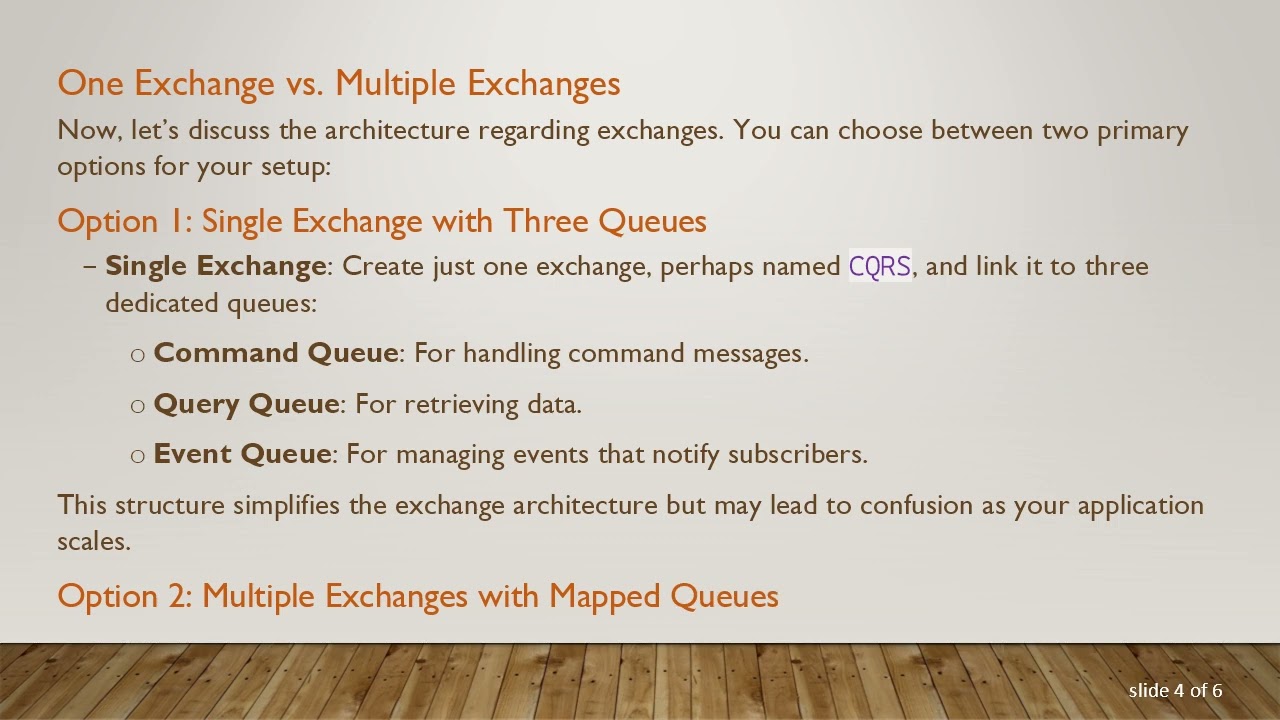
One Exchange vs. Multiple Exchanges
Now, let’s discuss the architecture regarding exchanges. You can choose between two primary options for your setup:
Option 1: Single Exchange with Three Queues
Single Exchange: Create just one exchange, perhaps named CQRS, and link it to three dedicated queues:
Command Queue: For handling command messages.
Query Queue: For retrieving data.
Event Queue: For managing events that notify subscribers.
This structure simplifies the exchange architecture but may lead to confusion as your application scales.
Option 2: Multiple Exchanges with Mapped Queues
Three Different Exchanges: Alternatively, you can choose to create one exchange for each type of bus — query_bus, command_bus, and event_bus. Each exchange will have a corresponding queue mapped within it for the specific commands, queries, or events using routing keys.
Benefits:
Clarity: Reduces complexity by segmenting functionalities.
Flexibility: Allows for easier changes or extensions in the future.
Which Option is Best for You?
The choice between using one exchange or multiple exchanges often depends on your project's complexity and growth potential. For many small to medium-sized applications, having a single exchange may suffice. However, as your application scales or if you're expecting considerable growth, it may be prudent to set up multiple exchanges with mapped queues for better organization and performance monitoring.
Conclusion
In conclusion, successfully organizing exchanges and queues in RabbitMQ greatly enhances the efficiency and manageability of your CQRS architecture. By utilizing separate queues for commands, queries, and events, and thoughtfully considering your exchange strategy, you can build a more resilient and scalable backend application.
Make the most of your RabbitMQ setup by adopting these best practices and don’t hesitate to delve deeper into RabbitMQ documentation for advanced configurations.
Доступные форматы для скачивания:
Скачать видео mp4
-
Информация по загрузке: