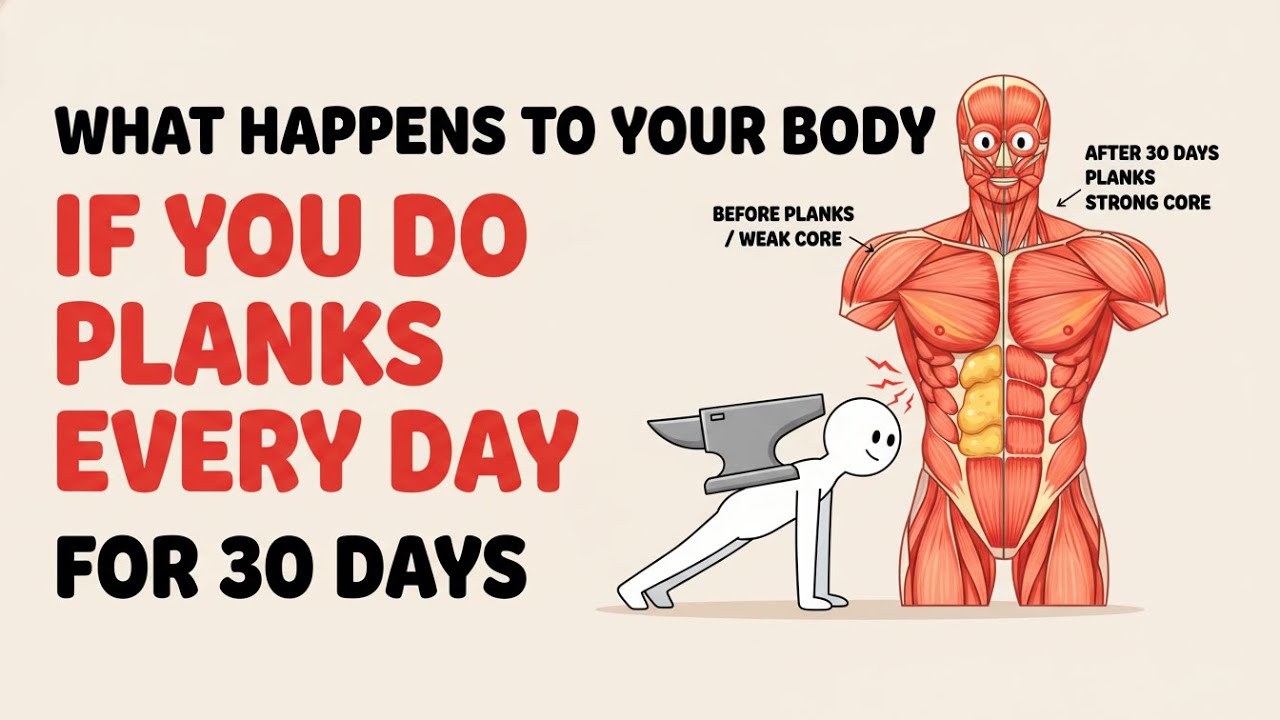
What Happens to Your Body If You Do Planks Every Day for 30 Days | Science Explained
Автор: Healthy Stickman Science
Загружено: 2026-01-08
Просмотров: 876
What Happens to Your Body If You Do Planks Every Day for 30 Days | Science Explained
Science Explained: Learn how doing planks every day for 30 days affects muscle activation, core stability, and overall physical function.
In this Science Explained video, we examine what happens to your body when you perform planks daily for 30 days and how this static exercise influences multiple muscle groups and movement patterns.
Planks primarily engage the core muscles, including the abdominals, lower back, and hip stabilizers, while also activating the shoulders, glutes, and legs. This video explains how consistent plank training may improve core endurance, postural control, and spinal stability over time, rather than increasing muscle size or strength dramatically.
We also explore how daily planking affects muscle coordination, joint loading, and fatigue management, and why progression, form, and recovery play an important role in long-term outcomes. The video explains both the potential benefits and limitations of doing planks every day, based on current exercise science.
Discover:
• How planks activate core and stabilizing muscles
• Changes in core endurance and postural control
• Effects on spinal stability and joint loading
• The role of form and progression in daily planking
• Why recovery still matters with static exercises
• What science says about planks after 30 days
📚 Sources:
McGill, S.M. (1998). "Low Back Exercises: Evidence for Improving Exercise Regimens." Physical Therapy, 78(7), 754-765.
Hodges, P.W., & Richardson, C.A. (1996). "Inefficient Muscular Stabilization of the Lumbar Spine Associated with Low Back Pain: A Motor Control Evaluation of Transversus Abdominis." Spine, 21(22), 2640-2650.
Janda, V. (1987). "Muscles and Motor Control in Low Back Pain: Assessment and Management." Physical Therapy of the Low Back, 253-278.
Key, J. (2010). "The 'Pelvic Crossed Syndromes': A Reflection of Imbalanced Function in the Myofascial System—A Clinical Effective Approach." Journal of Bodywork and Movement Therapies, 14(3), 299-301.
Folland, J.P., & Williams, A.G. (2007). "The Adaptations to Strength Training: Morphological and Neurological Contributions to Increased Strength." Sports Medicine, 37(2), 145-168.
Behm, D.G., & Anderson, K.G. (2006). "The Role of Instability with Resistance Training." Journal of Strength and Conditioning Research, 20(3), 716-722.
Cohen, R.A., et al. (2009). "Anterior Cingulate Cortex Involvement in the Effort of Decision Making." Nature Neuroscience, 12, 503-509.
Understanding how daily planks affect the body can help clarify what this exercise can and cannot do, and how to use it effectively as part of a balanced routine.
🔔 Like, subscribe, and share to learn how exercise affects your body through real science.
💬 Comment below: Do you include planks in your daily routine?#scienceexplains #kidney #fasting #healthscience explains #health #HealthyScienceStickman #PlankExercise #CoreStrength #Fitness
Доступные форматы для скачивания:
Скачать видео mp4
-
Информация по загрузке: