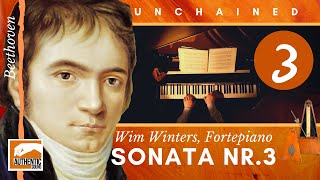
Beethoven: Sonata in F minor Op.2 n.1 - Historical Tempo Reconstruction - Pianoforte: Wim Winters
Автор: AuthenticSound
Загружено: 2020-05-11
Просмотров: 21861
The sonata in F minor op.2 n.1 is known today as Beethoven's first piano sonata. It belongs to the set of three piano sonatas op.2 the composer has published in 1796. Of course, these are not his first compositions, since Beethoven was already 26 years old when they got published, therefore it would be very interesting to have an insight of the background and history behind these early works and how Beethoven might have conceived them. (Read below)
00:00 - Allegro (H=104)
13:23 - Adagio (8th=80)
26:29 - Minuetto: Allegretto (H.=72)
32:16 - Prestissimo (H=120)
Tempi after Carl Czerny (1791-1857), read in WBMP ( • How Fast did Beethoven and Chopin really P... )
--
🙋We need YOU to continue in (full) speed!▶ / authenticsound
--
When he moved to Vienna in November 1792, Beethoven began to make himself known with various compositions for piano and the three sonatas op. 2 were published in 1796 and dedicated to Haydn, who the young composer studied with. These are the first compositions for piano that Beethoven numbered but not the first that he composed for instance, three so-called Kurfürsten Sonatas were written as early as 1783 (and published much later as a special request from Beethoven himself).
These works from his childhood could have been easily influenced by the set of 12 sonatas composed by Neefe in 1773, who had been at the time one of his teachers.
In the preface to his work, Neefe does not hide the fact that these sonatas had been expressively composed for the clavichord, and not for the harpsichord or the piano.
This is an important fact, since it helps us to understand that Beethoven might have applied the sustained and cantabile sound that could be obtained on the clavichord, on the improved late eighteenth century piano , and it is therefore very probable that Beethoven's conception of the piano performance was partly influenced by Neefe's preference for the clavichord. As it certainly has been the case for Mozart.
In this recording Wim followed the metronome numbers given by Czerny (Beethoven's most important student and life-long friend) and applied the WBMP (Whole Beat Metronome Practice). This was indeed the historical use of the metronome where the note value represented the periodical unity indicated by the full swing (back and forth) of the rod of the mechanical device, as the latter was directly inspired to the full swing of the pendulum or the up and down given by the conductor with his hand.
With this reading, the metronome number indicates the subdivision of the note value written in the equation, which is exactly the same way we still teach solfege to our kids today: one AND two AND three AND...
We hope you enjoy this beautiful sonata and don't miss the next recordings: a lot of AMAZING stuff is about to come on this channel!
Text: Alberto
📩One weekly mail in your mailbox? 👉http://bit.ly/as-mailinglist
--
📱 Website: ▶http://www.authenticsound.org

Доступные форматы для скачивания:
Скачать видео mp4
-
Информация по загрузке:


![[𝐩𝐥𝐚𝐲𝐥𝐢𝐬𝐭] A Very Winnie Pooh Timeless Christmas Jazz 🎄🎷 Classic Holiday Tunes with Vintage Charm](https://ricktube.ru/thumbnail/rGqm4gUt77I/mqdefault.jpg)